












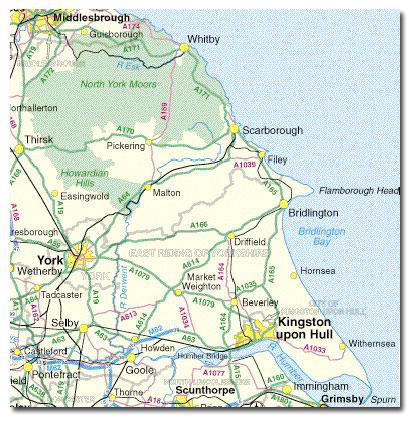
The East and North Ridings of Yorkshire
EAST RIDING: The landscape consists of a crescent of low chalk hills, the Yorkshire Wolds, surrounded by the low lying fertile plains of Holderness and the Vale of York. The Humber Estuary and North Sea mark its southern and eastern limits. Archaeological investigations have revealed artefacts and structures from all historical periods since the last ice age.
Geology
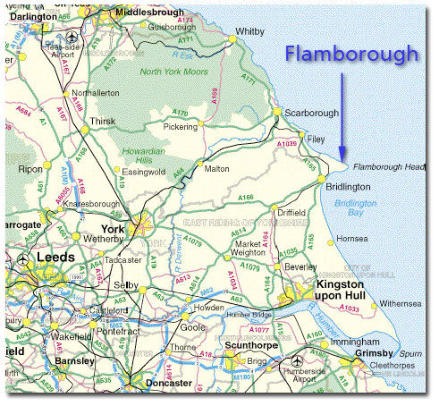
Geologically the East Riding district is split into three parts: the eastern section of the Vale of York (a belt of sandstone overlain by glacial deposits); the middle part is the Yorkshire Wolds, a chalk formation which extends from the Humber to the coast at Flamborough Head; while the south-east of the district is the low-lying coastal plain of Holderness, which faces east to the North Sea.Landscape
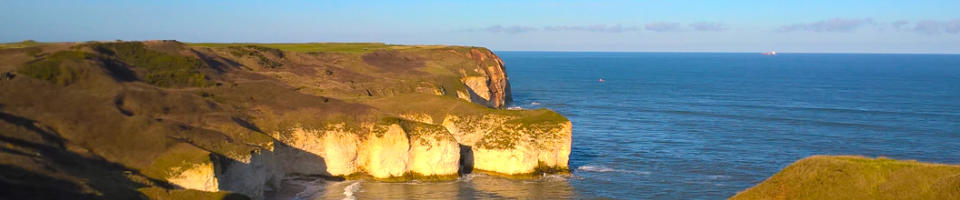
The Wolds area takes the form of an elevated, gently rolling plateau, cut by numerous deep, steep- sided, flat-bottomed valleys of glacial origin. Surface water is quite scarce throughout the Wolds. At Flamborough Head the Wolds rise up to form high chalk cliffs, where there are water-worn caves and stacks along the shore. Flamborough Headland is designated a Heritage Coast.Places of Interest
There is a wide range of interesting places to visit in the East Riding. These include historic buildings such as Burnby Hall, Burton Agnes Manor House, Burton Agnes Hall, Sewerby Hall, Skipsea Castle and the gun battery of Fort Paull. The religious edifices of the Rudston Monolith, Beverley Minster and Beverley Friary, and Howden Minster can be visited at all seasons.
As the range of our activities is so diverse, we have a number of different websites. The main Flamborough Manor
site, which is where you are now, focuses primarily on accommodation (bed & breakfast) but has brief details of
all our other activities. To allow for more information to be presented on these other activities, we have other self-
contained web-sites and some of the links you will encounter while browsing these pages will take you to these
separate sites. To return to this site, simply go to the LINKS page, which is common to all our sites.

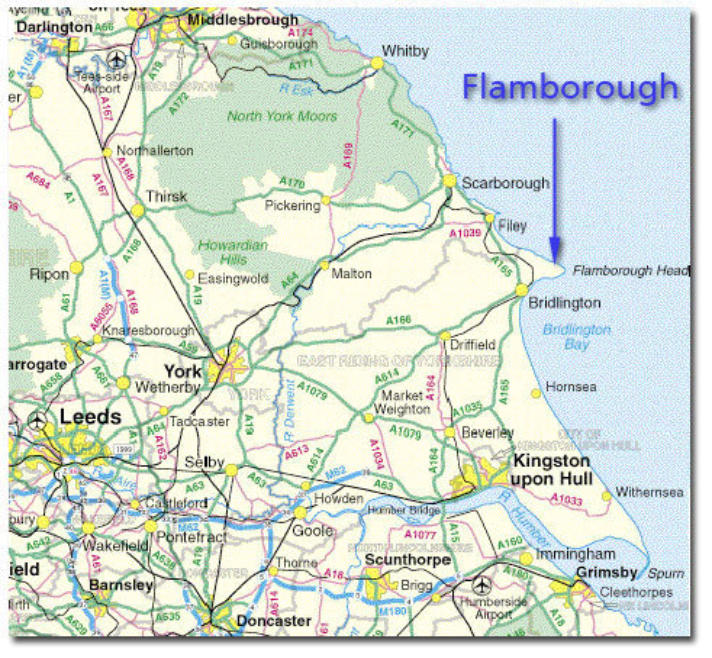
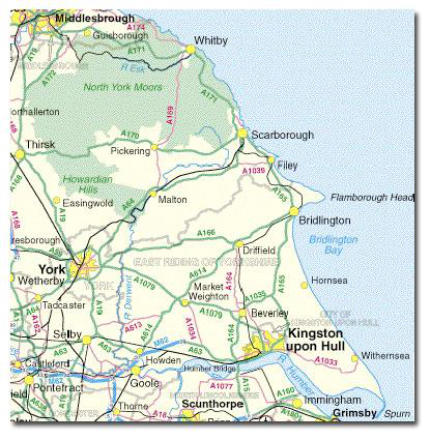
Flamborough is well situated for touring the
coast and places of interest in the East and
North Ridings of Yorkshire.
The cities of York and Hull are forty-four and
thirty-seven miles away respectively, while two
of the most interesting towns in the area —
Beverley to the south and Whitby to the north
— are within easy reach. Closer still are the
resort towns of Bridlington (4 miles) and
Scarborough (20 miles), as well as
picturesque, unspoiled, Filey (12 miles).
Country houses open to the public (not all
year round) include the magnificent Castle
Howard, delightful Burton Agnes Hall,
Sledmere House with its famous Turkish
room, Sewerby Hall, Burton Constable Hall
and Beningborough. Others sites of interest
are Kirkham Priory, Pickering and Helmsley
Castles and Wharram Percy, a deserted
medieval village.
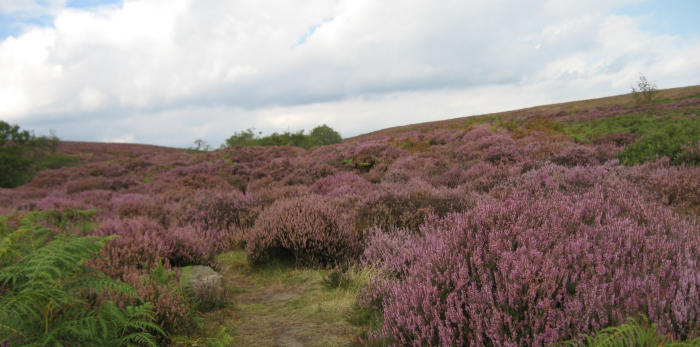
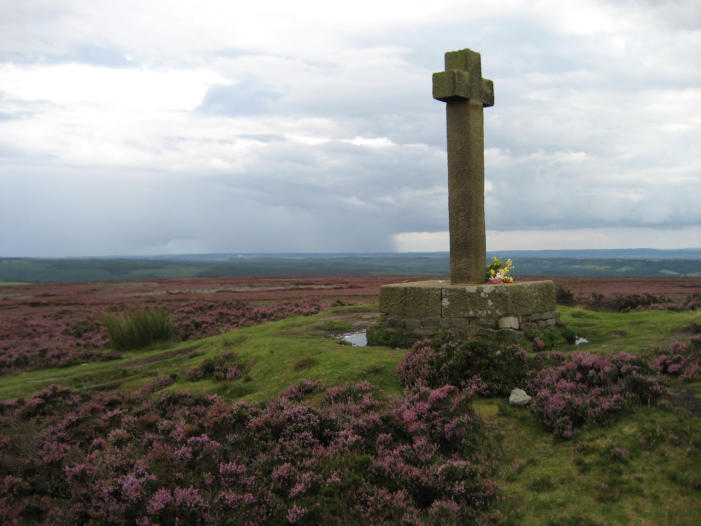
A considerable part of the North Riding has been preserved as the North York Moors National Park, through which
runs the North York Moors Railway, operating steam and diesel train trips through the Park. On the fringes of the Park
are the ruins of Rievaulx, Byland and Whitby Abbeys. Finally, dotted along the coast, are isolated fishing villages
redolent of another age. Perhaps best known is Robin Hood’s Bay; however, Runswick Bay and Staithes are well worth
a visit.
Burton Agnes Hall
A
Norman
Manor
house,
the
lower
chamber
of
which
still
remains,
was
first
constructed
on
this
site
in
1173.
Since
then
the
property
has
never
been
sold,
though
it
has
passed
from
family
to
family
on
occasions
when
the
male
line
has
ended.
In
1599
Sir
Henry
Griffith,
who
had
obtained
the
property
via
the
female
line,
began
construction
of
a
new
house
on
the
site,
using
the
architect
Robert
Smithson.
Smithson,
who
was
Master
Mason
to
Elizabeth
I,
also
built
Longleat,
Wollaton
and
Hardwick.
Building
was
complete
by
about
1610,
with
stone
quoins
contrasting
the
red-brick
of
the
house.
The
estate
subsequently
passed
to
the
Boynton
family
when
Sir
Henry
Griffith's
daughter
married
Sir
Matthew
Boynton,
and
remained
in
the
Boynton
family
until
the
end
of
the
eighteenth
century
when
the
estate
was
inherited
by
Cecily
Boynton,
who
married
Thomas
Lamplugh
Wickham.
Since
the
1950s
the
house
has
been
extensively
restored,
including
the
stunning
Long
Gallery. Now run by a registered charity, the estate remains a lived-in family home occupied by descendants of the Boynton family.
Castle Howard
In
1699
the
Third
Earl
of
Carlisle,
having
rejected
the
plans
of
a
leading
architect,
approached
the
dramatist
John
Vanbrugh,
who,
at
that
point,
had
never
built
anything
in
his
life.
Vanbrugh
subsequently
recruited
Nicholas
Hawksmoor
to
assist
him
in
the
practical
side
of
design
and
construction.
Although
the
final
western
wing
of
the
Garden
Front
was
completed
by
1709,
building
proceeded
for
the
next
century.
Indeed,
further
alterations
were
still
being
made
in
the
last
quarter
if
the
19th
century
as
part
of
a
plan
to
harmonize
both
wings.
Tragically,
on
the
morning
of
9
November
1940,
fire
broke
out
in
the
South-East
Wing
and
swept
through
the
house
into
the
Great
Hall,
destroying
the
dome
and
nearly
twenty
rooms.
In
1960-62
the
dome
was
rebuilt
and
redecorated,
and,
as
time
and
money
permit,
the
gradual
task
of
restoring
the
fire-damaged sections continues.
Whitby Abbey
Whitby
Abbey,
imposingly
sited
on
the
cliff
top,
was
founded
in
AD657.
Seven
years
later,
the
Synod
was
held
here
to
debate
the
dating
of
Easter.
The
Abbey
was
destroyed
during
a
Viking
invasion
in
AD867,
but
was
revived
by
one
of
William
the
Conqueror’s
knights
in
the
late
1070s.
By
1220,
the
Norman
church
proved
too
small
for
the
many
pilgrims
who
visited
it,
and
rebuilding
began.
However,
after
its
dissolution
in
1538,
the Abbey passed to the Cholmley family, whose house was constructed in large part from materials plundered from the monastery.
Approaching
the
Abbey
from
the
town
involves
a
climb
of
199
steps
(however,
car
access
is
available
from
the
south).
Be
sure
also
to
visit
the
exquisite St Mary's Church, with its unusual 18th century interior, carved by ship-builders.
Lastingham
Nestling
near
the
edge
of
the
North
York
Moors
National
Park,
close
to
the
picture-postcard
Hutton-le-Hole,
Lastingham
is
typical
of
the
unspoiled
Moors'
villages.
A
monastery
was
founded
here
in
654
by
St
Cedd,
and
flourished
until
the
Danes
destroyed
it
in
the
ninth
century.
In
1078
the
Abbot
of
Whitby
persuaded
the
King
to
restore
Lastingham,
and
work
began
on
the
abbey.
However,
only
the
crypt,
which
has
has
survived unaltered, was completed before the Abbot and his monks left abruptly to set up a new monastery in York.
Beverley
The
first
Saxon
Church
in
Beverley
was
established
by
John
of
Beverley
about
AD700.
By
AD937
a
second
church
had
been
built
to
replace
the
first,
and
this
church
was
granted
the
right
of
sanctuary
by
King
Athelstan.
This
second
church
was
subsequently
enlarged
but
by
about
1170
a
third
church,
this
time
built
in
the
Norman
Style,
replaced
the
old
Saxon
church.
The
current
Minster
was
commenced
about
1220,
with
the
construction
taking
two
centuries.
It
remains
to
this
day
one
of
the
best-loved
of
English
churches,
but
the
town
itself
is
also
not
be
missed.
It
remains a lively, thriving Wolds' market town with a wealth of historic architecture.

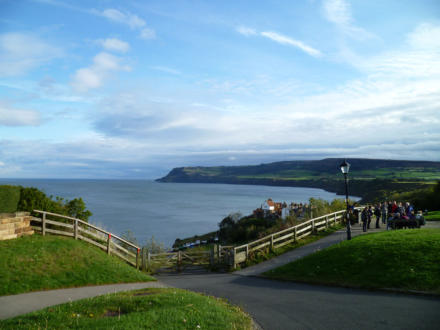
Robin Hood’s Bay
Located
a
few
miles
south
of
Whitby
is
the
dramatic
sweep
of
Robin
Hood's
Bay.
The
village
itself
nestles
in
a
cleft
and
is
barely
visible
in
the
photograph.
Car
parking
is
readily
available
at
the
top
of
the
village.
The
walk
down
to
the
beach
involves
a
steep
climb
back,
but
is
well
worth
the effort.
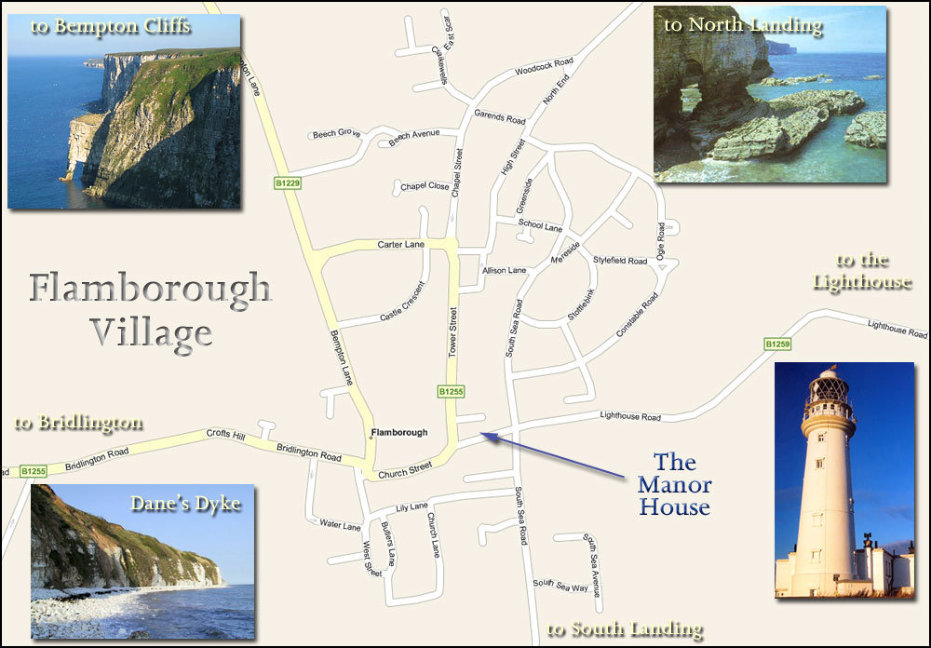
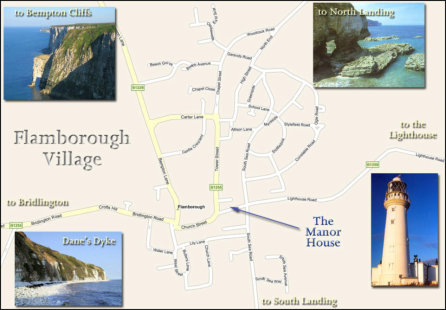
How to find us :
If
approaching
from
Bridlington
on
the
B1255,
the
road
sweeps
down
a
hill
into
the
village,
passing
Flamborough
Parish
Church
(St
Oswald’s)
on
the
right.
Just
past
the
church
the
road
turns
sharply
to
the
left
at
the
junction
of
Tower
Street
and
Lighthouse
Road.
The
Manor
House
is
on
this
corner,
but
you
must
turn
right
into
Lighthouse
Road
and
we
are
the
first
entrance
on
the
left.
Look
for
signs
announcing
"Antiques
and
Sweaters"
—
the
stable
at
the
front
of
the
house
has
been
converted
into
a
small
shop;
the
house
itself
is
set
back
from
the
road.
There
is
ample
parking
in
front
of
the
shop.
Please
note
that
the
Tower
Street
entrance to the property is no longer in use and that access is only available via Lighthouse Road.
If
approaching
from
the
Scarborough
direction
on
the
B1229
follow
the
signs
to
the
centre
of
the
village
(Post
Office
square)
and
then
turn
south
down
Tower
Street,
passing
the
field
with
the
remains
of
the
old
fortified
manor
on
the
right.
The
Manor
House
is
the
last
property
on
the
left.
As
mentioned
above,
please
note
that
the
Tower
Street
entrance
to
the
property
is
now
closed
and
that
access
is
only
available
via
Lighthouse
Road.
Please
turn
left
on
to
Lighthouse
Road
and
pull
in
to
the
first
drive
on the left. If you pass the church you have gone too far.
For
SatNav
or
Web-maps
please
ignore
our
official
postcode
of
YO15
1PD
(which
covers
all
of
Tower
Street)
and
use
this
postcode instead:
YO15 1PY
which will take you directly to the main entrance in Lighthouse Road.
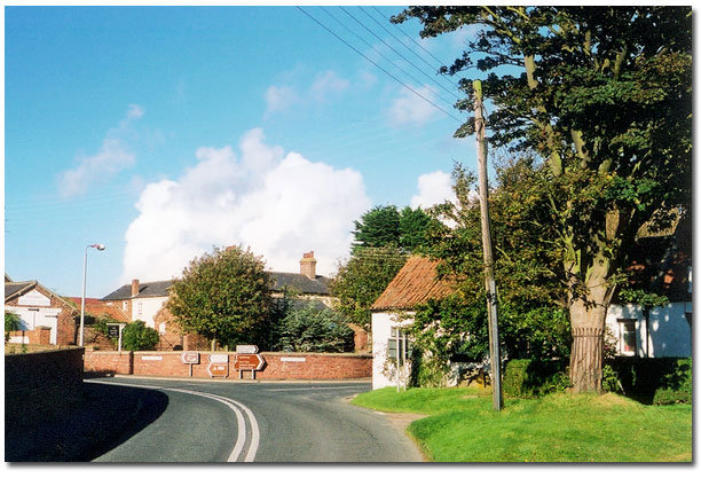
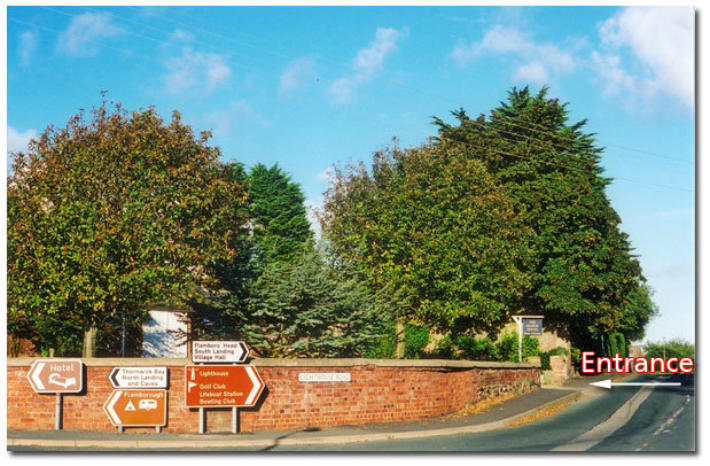
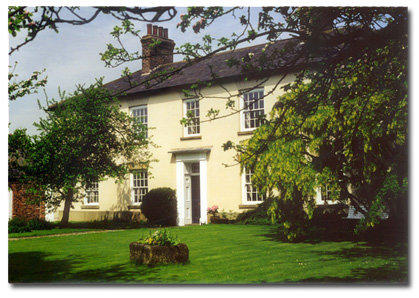
Approaching the corner of Tower Street and Lighthouse Road, just past the Church
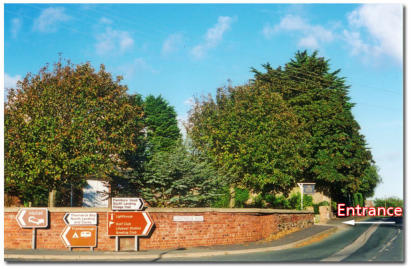
At the corner of Tower Street and Lighthouse Road, turn into Lighthouse Road :
the Manor House is the first entrance on the left (shown above).
For SatNav or Web-maps please ignore our official postcode of YO15 1PD
(which covers all of Tower Street) and use this postcode instead: YO15 1PY
which will take you directly to the main entrance in Lighthouse Road.
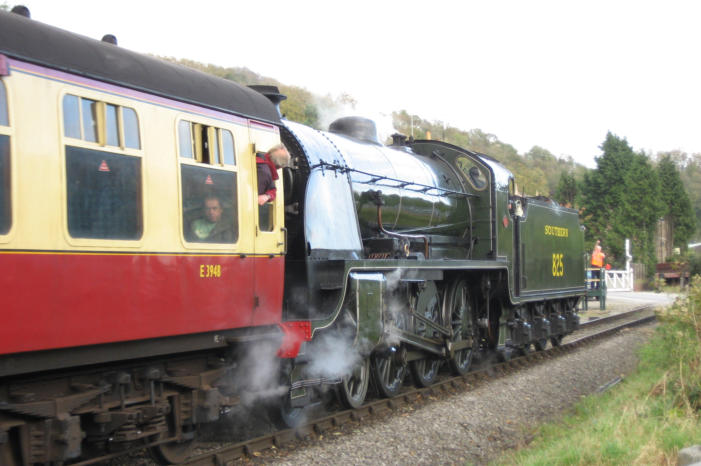
The North York Moors Railway
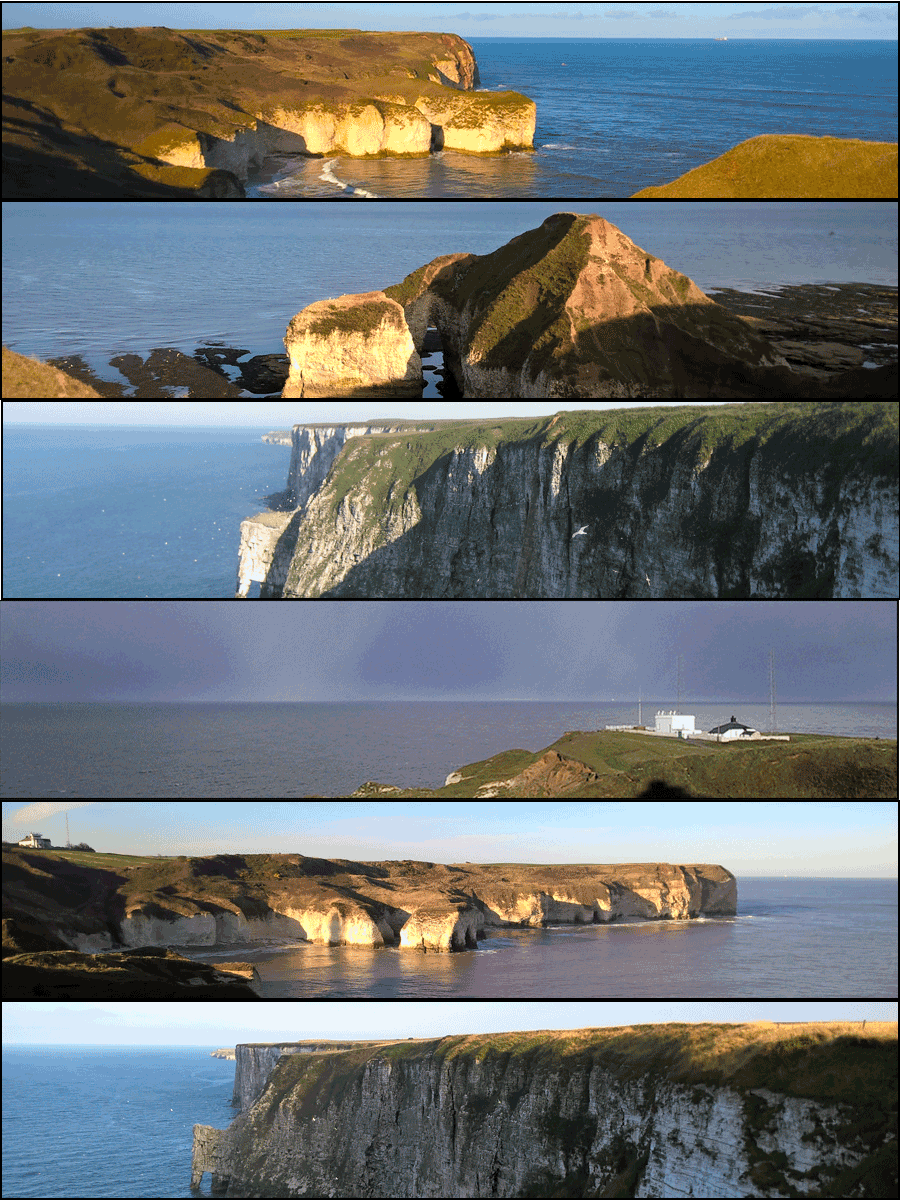
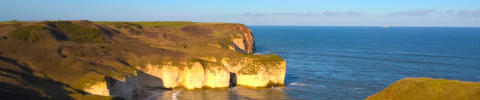
Views of Flamborough Head
The Manor House, Flamborough, Bridlington, East Riding of Yorkshire. YO15 1PD
Telephone: 01262 850943 [International: +44 1262 850943]
E-mail: gm@flamboroughmanor.co.uk
Web-site design & content Copyright © 2024 Geoffrey Miller
The Manor House
Accommodation, Books, Traditional Knitwear & Hand-Knitted Ganseys, Breton shirts
Lesley Berry and Geoffrey Miller
The Manor House
Flamborough
Bridlington
East Riding of Yorkshire YO15 1PD
United Kingdom
Telephone: 01262 850943 (Mobile 07718 415234)
International: +44 1262 850943
E-mail: gm@flamboroughmanor.co.uk











The East and North Ridings
of Yorkshire
EAST RIDING: The landscape consists of a crescent of low chalk hills, the Yorkshire Wolds, surrounded by the low lying fertile plains of Holderness and the Vale of York. The Humber Estuary and North Sea mark its southern and eastern limits. Archaeological investigations have revealed artefacts and structures from all historical periods since the last ice age.Places of Interest
There is a wide range of interesting places to visit in the East Riding. These include historic buildings such as Burnby Hall, Burton Agnes Manor House, Burton Agnes Hall, Sewerby Hall, Skipsea Castle and the gun battery of Fort Paull. The religious edifices of the Rudston Monolith, Beverley Minster and Beverley Friary, and Howden Minster can be visited at all seasons.
This is the mobile variant of our web-site, specially designed for
viewing on smartphones, but lacking some of the more detailed
information available on our full-size site..

Flamborough is well situated for touring the coast and places of interest
in the East and North Ridings of Yorkshire.
The cities of York and Hull are forty-four and thirty-seven miles away
respectively, while two of the most interesting towns in the area —
Beverley to the south and Whitby to the north — are within easy reach.
Closer still are the resort towns of Bridlington (4 miles) and Scarborough
(20 miles), as well as picturesque, unspoiled, Filey (12 miles).
Country houses open to the public (not all year round) include the
magnificent Castle Howard, delightful Burton Agnes Hall, Sledmere House
with its famous Turkish room, Sewerby Hall, Burton Constable Hall and
Beningborough. Others sites of interest are Kirkham Priory, Pickering and
Helmsley Castles and Wharram Percy, a deserted medieval village.
A considerable part of the North Riding has been preserved as the North
York Moors National Park, through which runs the North York Moors
Railway, operating steam and diesel train trips through the Park. On the
fringes of the Park are the ruins of Rievaulx, Byland and Whitby Abbeys.
Finally, dotted along the coast, are isolated fishing villages redolent of
another age. Perhaps best known is Robin Hood’s Bay; however,
Runswick Bay and Staithes are well worth a visit.
Burton Agnes Hall
A
Norman
Manor
house,
the
lower
chamber
of
which
still
remains,
was
first
constructed
on
this
site
in
1173.
Since
then
the
property
has
never
been
sold,
though
it
has
passed
from
family
to
family
on
occasions
when
the
male
line
has
ended.
In
1599
Sir
Henry
Griffith,
who
had
obtained
the
property
via
the
female
line,
began
construction
of
a
new
house
on
the
site,
using
the
architect
Robert
Smithson.
Smithson,
who
was
Master
Mason
to
Elizabeth
I,
also
built
Longleat,
Wollaton
and
Hardwick.
Building
was
complete
by
about
1610,
with
stone
quoins
contrasting
the
red-brick
of
the
house.
The
estate
subsequently
passed
to
the
Boynton
family
when
Sir
Henry
Griffith's
daughter
married
Sir
Matthew
Boynton,
and
remained
in
the
Boynton
family
until
the
end
of
the
eighteenth
century
when
the
estate
was
inherited
by
Cecily
Boynton,
who
married
Thomas
Lamplugh
Wickham.
Since
the
1950s
the
house
has
been
extensively
restored,
including
the
stunning
Long
Gallery.
Now
run
by
a
registered
charity,
the
estate
remains
a
lived-in
family
home
occupied
by
descendants
of
the
Boynton family.
Castle Howard
In
1699
the
Third
Earl
of
Carlisle,
having
rejected
the
plans
of
a
leading
architect,
approached
the
dramatist
John
Vanbrugh,
who,
at
that
point,
had
never
built
anything
in
his
life.
Vanbrugh
subsequently
recruited
Nicholas
Hawksmoor
to
assist
him
in
the
practical
side
of
design
and
construction.
Although
the
final
western
wing
of
the
Garden
Front
was
completed
by
1709,
building
proceeded
for
the
next
century.
Indeed,
further
alterations
were
still
being
made
in
the
last
quarter
if
the
19th
century
as
part
of
a
plan
to
harmonize
both
wings.
Tragically,
on
the
morning
of
9
November
1940,
fire
broke
out
in
the
South-East
Wing
and
swept
through
the
house
into
the
Great
Hall,
destroying
the
dome
and
nearly
twenty
rooms.
In
1960-62
the
dome
was
rebuilt
and
redecorated,
and,
as
time
and
money
permit,
the
gradual
task
of
restoring
the
fire-
damaged sections continues.
Whitby Abbey
Whitby
Abbey,
imposingly
sited
on
the
cliff
top,
was
founded
in
AD657.
Seven
years
later,
the
Synod
was
held
here
to
debate
the
dating
of
Easter.
The
Abbey
was
destroyed
during
a
Viking
invasion
in
AD867,
but
was
revived
by
one
of
William
the
Conqueror’s
knights
in
the
late
1070s.
By
1220,
the
Norman
church
proved
too
small
for
the
many
pilgrims
who
visited
it,
and
rebuilding
began.
However,
after
its
dissolution
in
1538,
the
Abbey
passed
to
the
Cholmley
family,
whose
house
was
constructed
in
large part from materials plundered from the monastery.
Approaching
the
Abbey
from
the
town
involves
a
climb
of
199
steps
(however,
car
access
is
available
from
the
south).
Be
sure
also
to
visit
the
exquisite
St
Mary's
Church,
with
its
unusual
18th
century
interior,
carved
by ship-builders.
Lastingham
Nestling
near
the
edge
of
the
North
York
Moors
National
Park,
close
to
the
picture-postcard
Hutton-le-Hole,
Lastingham
is
typical
of
the
unspoiled
Moors'
villages.
A
monastery
was
founded
here
in
654
by
St
Cedd,
and
flourished
until
the
Danes
destroyed
it
in
the
ninth
century.
In
1078
the
Abbot
of
Whitby
persuaded
the
King
to
restore
Lastingham,
and
work
began
on
the
abbey.
However,
only
the
crypt,
which
has
has
survived
unaltered,
was
completed
before
the
Abbot
and
his
monks
left
abruptly to set up a new monastery in York.
Beverley
The
first
Saxon
Church
in
Beverley
was
established
by
John
of
Beverley
about
AD700.
By
AD937
a
second
church
had
been
built
to
replace
the
first,
and
this
church
was
granted
the
right
of
sanctuary
by
King
Athelstan.
This
second
church
was
subsequently
enlarged
but
by
about
1170
a
third
church,
this
time
built
in
the
Norman
Style,
replaced
the
old
Saxon
church.
The
current
Minster
was
commenced
about
1220,
with
the
construction
taking
two
centuries.
It
remains
to
this
day
one
of
the
best-
loved
of
English
churches,
but
the
town
itself
is
also
not
be
missed.
It
remains
a
lively,
thriving
Wolds'
market
town
with
a
wealth
of
historic
architecture.

Robin Hood’s Bay
Located
a
few
miles
south
of
Whitby
is
the
dramatic
sweep
of
Robin
Hood's
Bay.
The
village
itself
nestles
in
a
cleft
and
is
barely
visible
in
the
photograph.
Car
parking
is
readily
available
at
the
top
of
the
village.
The
walk
down
to
the
beach
involves
a
steep
climb
back,
but
is
well
worth
the
effort.
How to find us :
If
approaching
from
Bridlington
on
the
B1255,
the
road
sweeps
down
a
hill
into
the
village,
passing
Flamborough
Parish
Church
(St
Oswald’s)
on
the
right.
Just
past
the
church
the
road
turns
sharply
to
the
left
at
the
junction
of
Tower
Street
and
Lighthouse
Road.
The
Manor
House
is
on
this
corner,
but
you
must
turn
right
into
Lighthouse
Road
and
we
are
the
first
entrance
on
the
left.
Look
for
signs
announcing
"Antiques
and
Sweaters"
—
the
stable
at
the
front
of
the
house
has
been
converted
into
a
small
shop;
the
house
itself
is
set
back
from
the
road.
There
is
ample
parking
in
front
of
the
shop.
Please
note
that
the
Tower
Street
entrance
to
the
property
is
no
longer
in
use
and
that
access
is
only
available
via Lighthouse Road.
If
approaching
from
the
Scarborough
direction
on
the
B1229
follow
the
signs
to
the
centre
of
the
village
(Post
Office
square)
and
then
turn
south
down
Tower
Street,
passing
the
field
with
the
remains
of
the
old
fortified
manor
on
the
right.
The
Manor
House
is
the
last
property
on
the
left.
As
mentioned
above,
please
note
that
the
Tower
Street
entrance
to
the
property
is
now
closed
and
that
access
is
only
available
via
Lighthouse
Road.
Please
turn
left
on
to
Lighthouse
Road
and
pull
in
to
the
first
drive
on
the
left.
If
you
pass
the
church
you
have
gone
too far.
For
SatNav
or
Web-maps
please
ignore
our
official
postcode
of
YO15
1PD
(which
covers
all
of
Tower
Street)
and
use
this
postcode
instead:
YO15
1PY
which
will
take
you
directly
to
the
main entrance in Lighthouse Road.
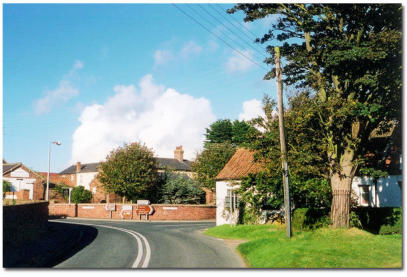
Approaching the corner of Tower Street and
Lighthouse Road, just past the Church
At the corner of Tower Street and Lighthouse Road, turn
into Lighthouse Road : the Manor House is the first
entrance on the left (shown above).
For SatNav or Web-maps please ignore our
official postcode of YO15 1PD (which covers
all of Tower Street) and use this postcode
instead: YO15 1PY which will take you directly
to the main entrance in Lighthouse Road.
Views of Flamborough Head
Web-site design & content Copyright © 2019 Geoffrey Miller
The Manor House
Accommodation, Books, Traditional Knitwear &
Hand-Knitted Ganseys, Breton shirts
Lesley Berry and Geoffrey Miller
The Manor House
Flamborough
Bridlington
East Riding of Yorkshire YO15 1PD
United Kingdom
Telephone: 01262 850943 (Mobile 07718 415234)
International: +44 1262 850943
E-mail: gm@flamboroughmanor.co.uk
The Manor House
Flamborough
Bridlington
East Riding of Yorkshire
Telephone
01262 850943
The Manor House, Flamborough, Bridlington, East Riding of Yorkshire. YO15 1PD
Telephone: 01262 850943 [International: +44 1262 850943]
E-mail: gm@flamboroughmanor.co.uk
Web-site design & content Copyright © 2024 Geoffrey Miller