




Contact Information
Flamborough Marine Limited
The Manor House
Flamborough
Bridlington
East Riding of Yorkshire
YO15 1PD
United Kingdom
Telephone:
01262 850943
International:
+44 1262 850943
E-mail:
gm@flamboroughmarine.co.uk
For authentic hand-knitted Ganseys and Gansey Knitting Kits

Flamborough Marine Limited : Traditional Knitwear : Hand-Knitted Ganseys
The Manor House, Flamborough, Bridlington, East Riding of Yorkshire. YO15 1PD
Telephone: 01262 850943 [International: +44 1262 850943]
E-mail: gm@flamboroughmarine.co.uk
Few occupations are more at the mercy of the wind and weather than fishing. And it was the
practical requirement for warm yet unencumbering clothing that prompted the development
of a fascinating tradition in fishermen’s sweaters, variously known as jerseys, Guernseys and
Ganseys.
It is likely that the word ‘jersey’, used to describe a knitted garment, owes its derivation to the
name of the largest of the Channel Islands, where worsted spinning was once a staple
industry. Over a period of time, the close-fitting garments knitted in worsted-spun yarn made
in Jersey, and favoured by sailors and fishermen, became known as jerseys.
Similarly, the neighbouring island of Guernsey gave its name to the classic square-shaped
wool sweater, which was designed with a straight neck so that it could be reversed. Gansey, a
term which crops up in the writings of both Samuel Beckett and James Joyce, is a dialect
variation of Guernsey.
Until the coming of the machine age in the nineteenth century, most industries were small-
scale and craft-based. As early as 1589, however, the invention of the knitting frame by
William Lee, a brilliant Nottinghamshire clergyman, had put into motion the gradual migration
of hosiery manufacturing from the domestic setting to the factory. The uptake of machines
was uneven, with pockets of the knitting industry, such as the famous knitters of Dent who
made small items on short needles, resisting change for many years.
The production of heavier gauge knitwear remained a largely domestic activity until much
more recently, with women knitting for entire families well within living memory. Every village
shop would have boasted a section devoted to knitting yarn, and the market towns would have had at least one thriving wool shop.
The isolated communities along the rugged British coastline were, by necessity, even more self-sufficient than those further inland. In the poor
fishing communities, families could ill afford the luxury of goods imported from the outside world. Women knitted for their sweethearts,
husbands and children. At a time when resources were scarce, outgrown clothes were passed down and adults’ garments cut down and remade
for children.
Visitors to the Yorkshire fishing ports such as Whitby and Filey and tiny villages such as
Seahouses on the rugged Northumberland coast, reported seeing women sitting in their
doorways busy with their needles. Never wasting a moment that could be used to earn an
extra penny, women worked late into the evening by the light of rush lamps, knitting the
navy-coloured yarn more by feel than by eye.
Although the classic Guernsey sweater remained plain (some Guernsey parishes did,
however, have their own patterns), the stitch patterns used became more complicated the
further north the garment spread, with the most complex evolving in the Scottish fishing
villages. These elaborate patterns came south with the Scottish herring fleet, as the women
folk followed their husbands down the coast to gut the fish. Thus the pattern known as
Whitby flag is in fact an interpretation of a Scottish design.
Young women, who had received little formal education, would develop the ability to
memorize complicated patterns, which were passed down from mother to daughter,
gathering new variations with each generation. The garments were made on five or more
needles, often called “wires” or “pins”, so as to be seamless. It was not unusual for men,
too, to knit ganseys. Knitting was a natural extension of the familiar tasks of making and
mending fishing nets, routine jobs which required considerable dexterity.
Tightly knitted in worsted yarn the fisherman’s Gansey was virtually wind-proof and water-
proof. As these working garments were rarely washed, there is no doubt that a layer of filth
would have added to the general protective effect. It is consoling to learn that fishermen
had “Sunday best” Ganseys which, being decidedly more fragrant, were worn for church
and on high days and holidays.
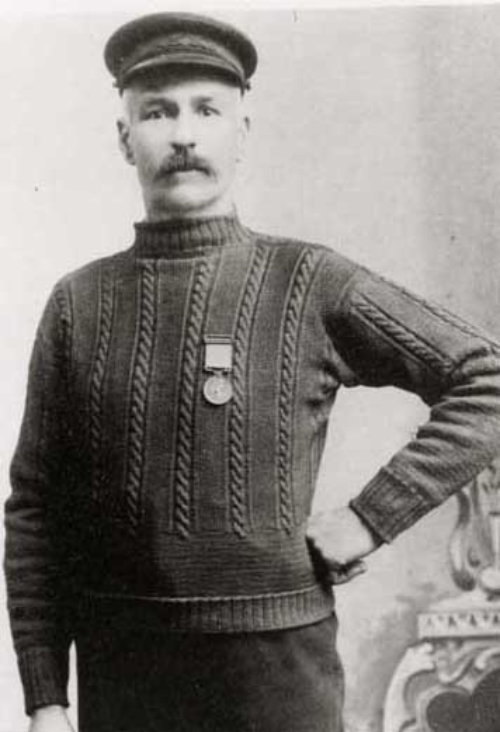
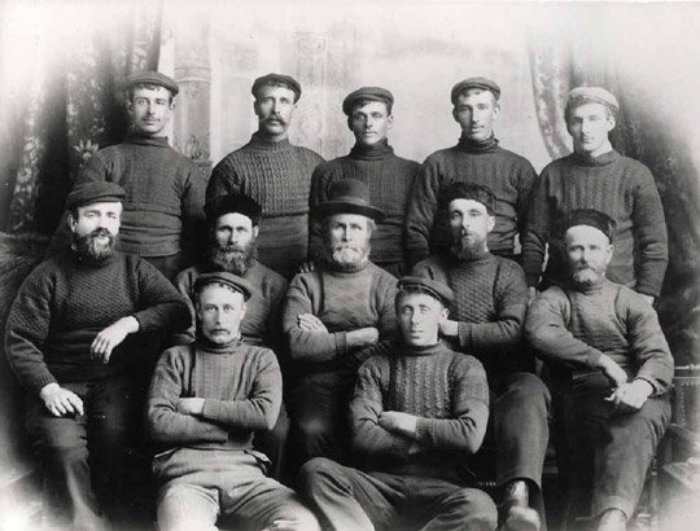
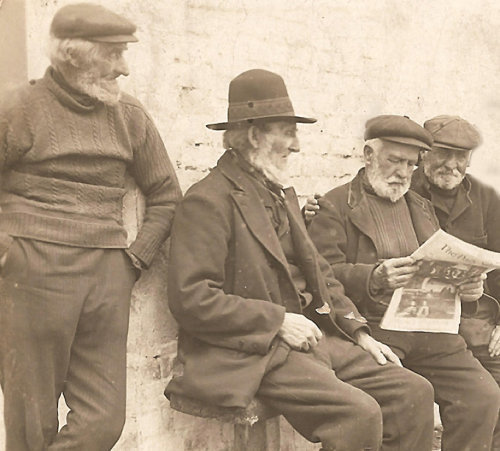
Many venerable Ganseys appear in the sepia toned photographs taken by the well-known
Whitby photographer Frank Meadow Sutcliffe from 1880 to the turn of the nineteenth
century. Prints made from Sutcliffe’s original glass plates provide a fascinating insight into
the clothing of ordinary working people. The characteristic, almost tubular, shape of the fisherman’s Gansey was dictated by practicality. The
welt, neck and cuffs were knitted tight so as to keep out winter blasts. According to hearsay, so tight were the Ganseys knitted for the
unfortunate children of one fisherman that, when the garments were pulled over their heads, the children’s ear lobes bled.
The cuffs, also made to be close-fitting, generally ended short of the wrist to avoid impeding the hands and becoming soaked with sea water as
the men worked. The close fitting design also helped to reduce the chances of the hem or cuffs becoming caught on pieces of equipment or
tackle, a mishap which could prove fatal. As time took its toll on the cuffs and elbows, the lower half of the sleeves could be unravelled and re-
knitted with new yarn. Garments made in various shades of blue, ranging from deep navy to a hue faded with age, were a common sight.
The upper part of the body was knitted more densely than the lower part to provide extra warmth, and it was on the yoke and upper arms that
the knitters had the opportunity to show off their knitting skills and to elaborate on the basic stocking stitch with numerous variations. For
detailed records of the many local interpretations of traditional fishermen’s jerseys, we are indebted to the tireless efforts of Gladys Thompson,
who, in the 1950s, pencil and paper in hand, scoured the fishing ports on the east coast—from Sheringham and Cromer in Norfolk as far as
Upper Largo in Fife.
Her quest, fired by a determination to preserve for future generations patterns which were seldom written down, took her down the narrow
harbour ginnels (passages) and into the cramped fishermen’s cottages, where often a single room served as kitchen, bedroom and living room,
with an attic above for storing and mending nets. On one occasion Gladys Thompson describes how, on the track of two knitters who lived on
Holy Island, she hired a young lad to drive her across to the island from Berwick. He arrived in a car at least thirty years old and covered with
rust and sand. Their journey, made before the causeway linking the island to the mainland was built, entailed driving through the sea which
surged into the ancient car through the floor boards.
Many of the stitch motifs used to decorate the Ganseys were inspired by the everyday objects in the lives of fishing families. Some of the best-
known designs represent ropes, nets, anchors and herringbone. Other patterns are based on the weather, echoing the shapes made by waves,
hail or flashes of lighting. Some patterns had more complex symbolic meanings. One of the traditional Filey patterns, for example, is a zigzag
design called “marriage lines” which represents the ups and downs of married life.
It was even possible for fishing families to recognize from the pattern of a Gansey, which fishing village, or even which family, the wearer came
from. At a time when the loss of a boat was a frequent occurrence, deliberate mistakes or the wearer’s initials were often incorporated into the
design in order to help to identify a body recovered from the sea. As the Gansey was was traditionally worn tight-fitting and close to the skin,
and with no seams to come apart, it could not be washed off in the water.
By tradition, the sweaters worn by all kinds of seafarers, whether they be fishermen, naval or retired sea salts, are navy blue—a colour reflecting
the sea and sky. Before the advent of synthetic dyes in the late nineteenth century, blue was obtained by using natural indigo, a plant extract
imported from India. However, summer weight Ganseys, knitted in a three- or four-ply yarn rather than the usual five-ply, were sometimes pale
grey or fawn. In a world which is becoming increasingly global in popular culture, the preservation of our traditional craft takes on a fresh
urgency.

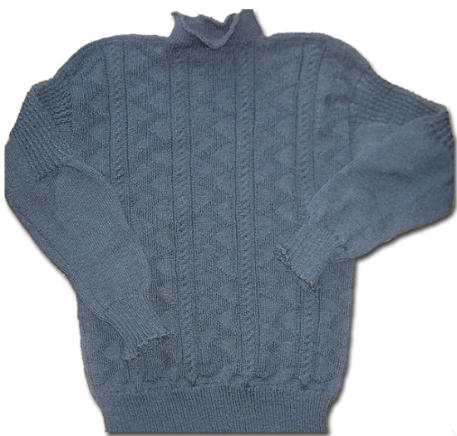
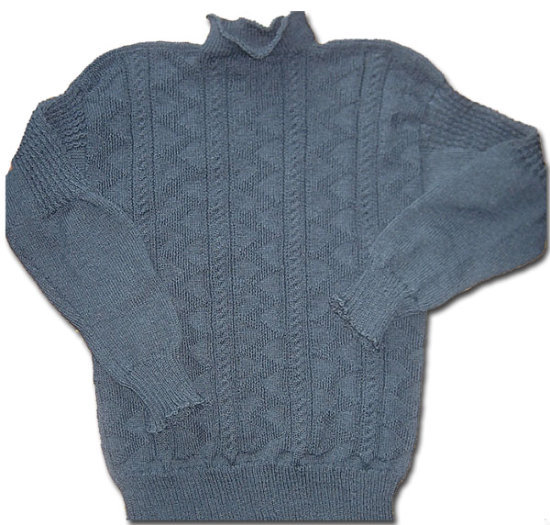
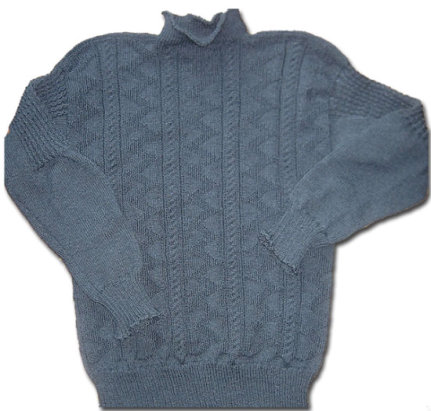
Two vintage
Ganseys:
Newbiggin (above) and Cullercoats Rocket Brigade (right, with the neck having been re-knitted)
Authentic hand-knitted Ganseys in 5-ply worsted wool, and Gansey Knitting Kits

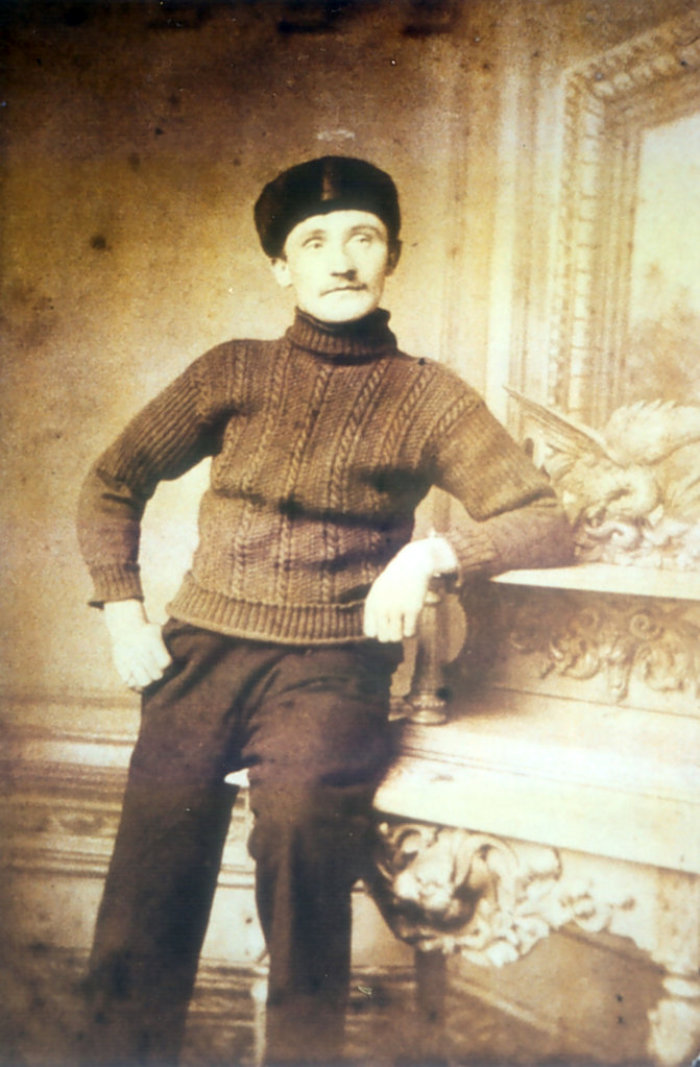
The print above left, showing a fisherman running through the streets of
a small northern fishing village shouting "All hands man the Life-Boat!" is
dated 26 November 1887. The fisherman is clearly wearing a Gansey
which, upon closer inspection, is almost certainly that of the Cullercoats
Rocket Brigade (an example of this pattern is shown below).
Over a century later, the same pattern can be knitted, and in the same
method, all-in-one piece, on five needles, in the finest quality 5-ply
worsted wool. If the fisherman returned today, he would find a few
things still familiar in Flamborough, and much that was alien. The fishing
boats (known locally as "cobles") would still be instantly recognizable, as
would Flamborough lighthouse and, if he walked into the premises of
Flamborough Marine, upon my soul, he would find a match for his own
Gansey.
A Unique Garment
The photograph at left shows Jack Cross of Flamborough mending his pots. The photograph was taken shortly before Jack and his two eldest sons were drowned at North Landing, Flamborough on Friday 5 February 1909 while trying to land their catch in a gale. The photograph was kindly donated by the third son, the late Mr Edward Cross, who is the small boy standing in the cottage doorway behind his father. Old sepia photographs evoke the romance of far-off times. Yet there was little romantic in the life of a North Sea fisherman at the turn of the century when most days involved a struggle against the elements. Life could be just as hard for the womenfolk. Days were long but, in addition to such essential tasks as baiting the lines, time would be set aside for Gansey knitting, either for members of the immediate family or else for sale to raise a few extra shillings. Great pride was taken in this knitting, especially for the ‘Sunday best’ Gansey (often not in the traditional navy) to be worn at such occasions as the Flamborough sword-dancing or Filey fishermen’s choir, both of which still thrive today. At some time past the custom arose that each fishing community would have its own identifiable pattern based on a selection of motifs related to the sea: nets, ropes, ladders, herringbones, and so on. Although it is now impossible to ascertain precisely when the patterns came into being, this style of knitting originated during the reign of Elizabeth I and the patterns were fixed by the beginning of the nineteenth century. This means that it is possible to tell where a fisherman came from by the pattern on his Gansey; it is also the factor which, more than anything, makes the Gansey unique. Eventually, however, the craft of Gansey knitting went into steady decline as younger people moved out of the fishing villages and was in danger of dying out completely. Each Gansey is a living part of history and we believe it is essential that the craft is maintained and nourished. Every Gansey tells its own story. This was originally for a very practical, if morbid, reason. As each village fishing community could be identified by the design on its Gansey, if the body of a fisherman was found it could then be returned to his home for burial. In larger fishing communities, small alterations to the basic pattern could even allow for the differentiation of families within that village. Indeed, it is perhaps not too great an exaggeration to say that Ganseys helped foster the community spirit. Today that spirit is alive and well and Ganseys are still being worn, not only by those who work in them, but also by those who appreciate the workmanship, history, and beauty of these remarkable sweaters. Note that the patterning is the same, back and front. This means that the Gansey is reversible, so that areas which come in for heavier wear, such as the elbows, can be alternated. Traditional Ganseys are knitted in the round, apart from the chest and back, which are knitted back and forth on two needles before being joined at the shoulders. They are a snug fit; a baggy sweater would be a liability on a fishing boat. The fake “side seams,” usually just a row of purl stitches at the sides, serve to keep the knitter on track. They are where adjustments can be made in size, without compromising or interfering with the main pattern.

Web-site design & content Copyright © 2026 Geoffrey Miller

Victorian Fishermen
Flamborough
Head

Flamborough Marine
Your source for authentic
hand-knitted Ganseys and
Gansey Knitting Kits
We pride ourselves on our personal
attention to detail. If you are at all
unsure about any aspect of our
products, telephone, write or e-mail
us with your query which will be
answered promptly and, we hope,
knowledgeably. We wish to ensure
that you are completely satisfied
before making a purchase, as well
as after.

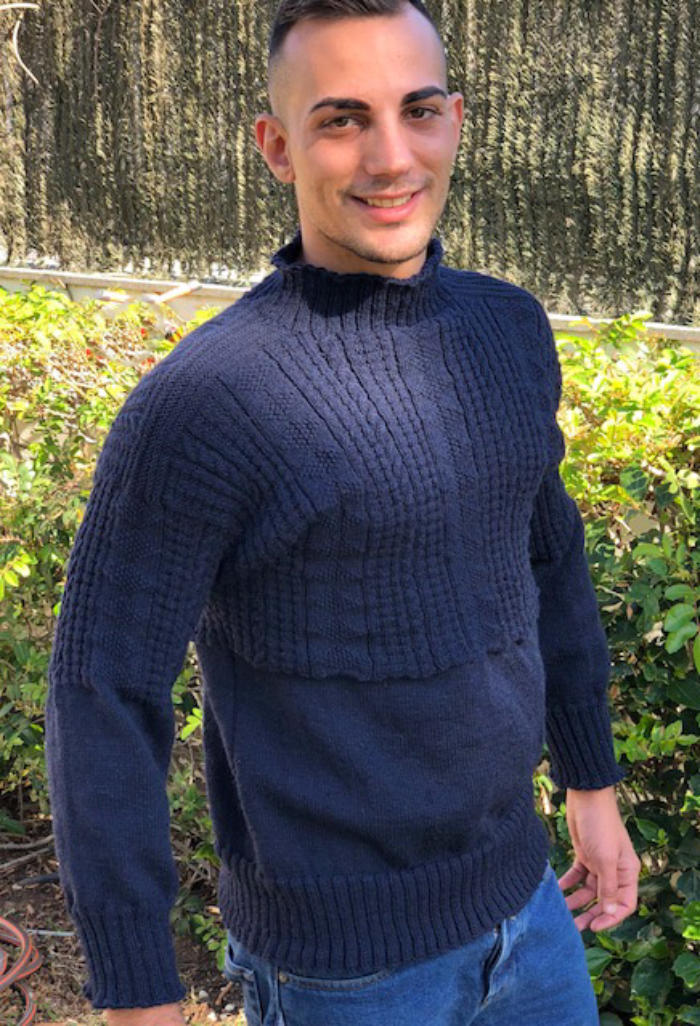
This stunning Aran pattern shown
above (a one-off commission)
shows what our talented knitters
are capable of.
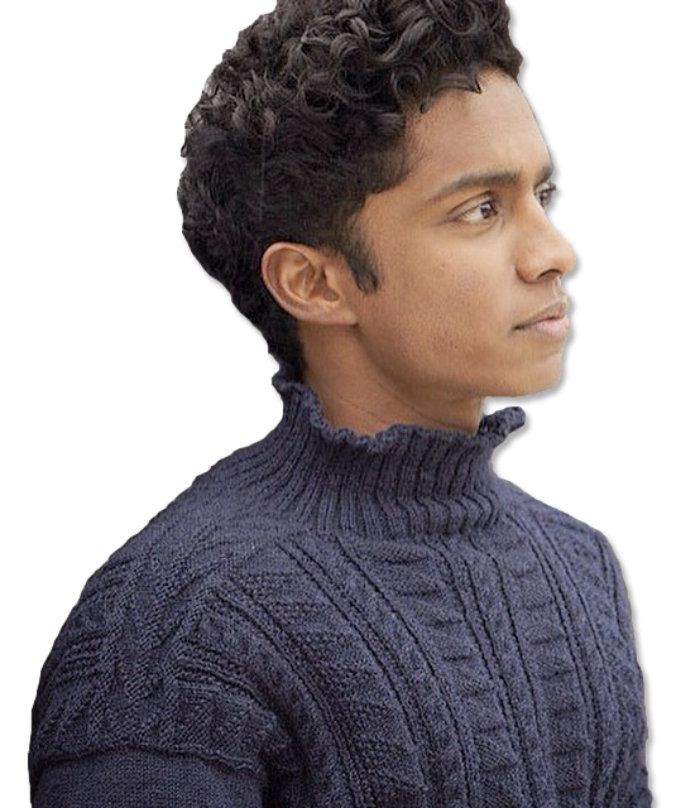
Rajiv Surendra wearing his specially-commissioned Gansey
At left: a classic
Whitby Gansey in Dark
Navy 5-ply worsted
wool
Flamborough Marine : The Manor House : Flamborough : Bridlington : East Riding of Yorkshire Telephone 01262 850943
If your browser indicates that this site is not secure, please click HERE to go to the secure version.
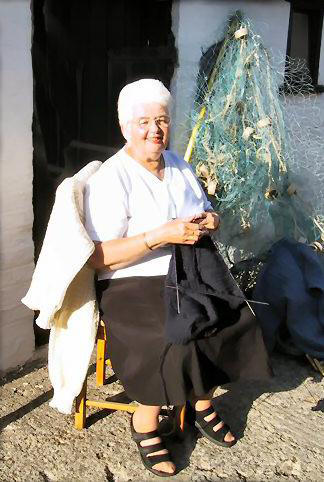
The Gansey Girl (below) immortalizes the tradition of Gansey knitting in
bronze. Situated on the harbour in Bridlington, with Flamborough Head in
the background, the statue, created by Steve Carvill (with some input from
my late wife, Lesley) depicts a fisherman’s wife knitting a Gansey.
Photographs kindly supplied by Kevin Groocock of H&K Bempton Crafts


The coble, Gansey Lass, under sail off Flamborough Head


We
recently
received
this
message
from
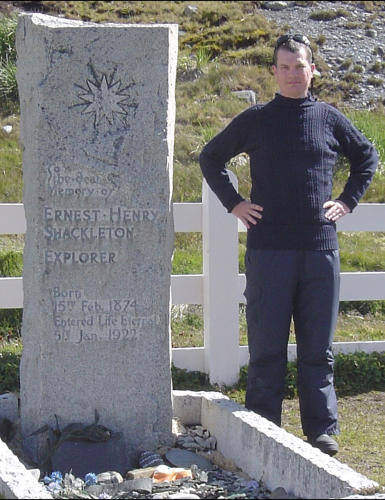
Eric
Taylor:
"11
years
ago
I
travelled
to
the
Antarctic
and
South
Georgia,
taking
with
me
the
Flamborough
pattern
Gansey
that
my
wife
had
knitted
for
me
from
a
kit
she
bought
from
you.
I
was
just
going
through
my
old
photos
and
found
this
one
of
me
by
Ernest
Shackleton’s
grave
at
Grytviken
on
South
Georgia
.
.
.
I
still
wear
my
Gansey
very
regularly
during
the
winter,
and
it’s
as
fantastic
now
as
it
was
when
I
was
first
given
it!"
Also
shown
is
a
photograph
of
Ernest
Shackleton,
clearly
wearing
a
Gansey
(though
not
one of ours!).

Gansey Price List
Size (inches/cm)
38" chest
97cm
£500
40" chest
102cm
£510
42" chest
107cm
£520
44" chest
112cm
£530
46" chest
117cm
£540
48" chest
122cm
£550
50" chest
127cm
£570
Larger or smaller, please inquire
For U. S. orders, please add 10%
tariff and 16% duty
When Lesley Berry initially conceived the idea to try to revive the dying craft of
Gansey knitting in 1981, the first task was to recruit knitters of the requisite
standard, which proved easier said than done. However, the first knitter taken on
was to prove of exceptional ability starting a friendship which has lasted till the
present day. Marion Brocklehurst went on to produce a regular supply of Ganseys
over the next forty years, eventually totalling over five hundred, of all sizes and
patterns.
Marion also was our expert for Special Commissions and it was as a result of this,
after we had been approached by Rajiv Surendra in 2012, that she produced the
exquisite Gansey shown here. Marion went on to knit further Ganseys for Rajiv and
Rajiv, in turn, has produced an excellent video on Gansey Knitting which, in addition
to detailing the history, also pays tribute to Marion.
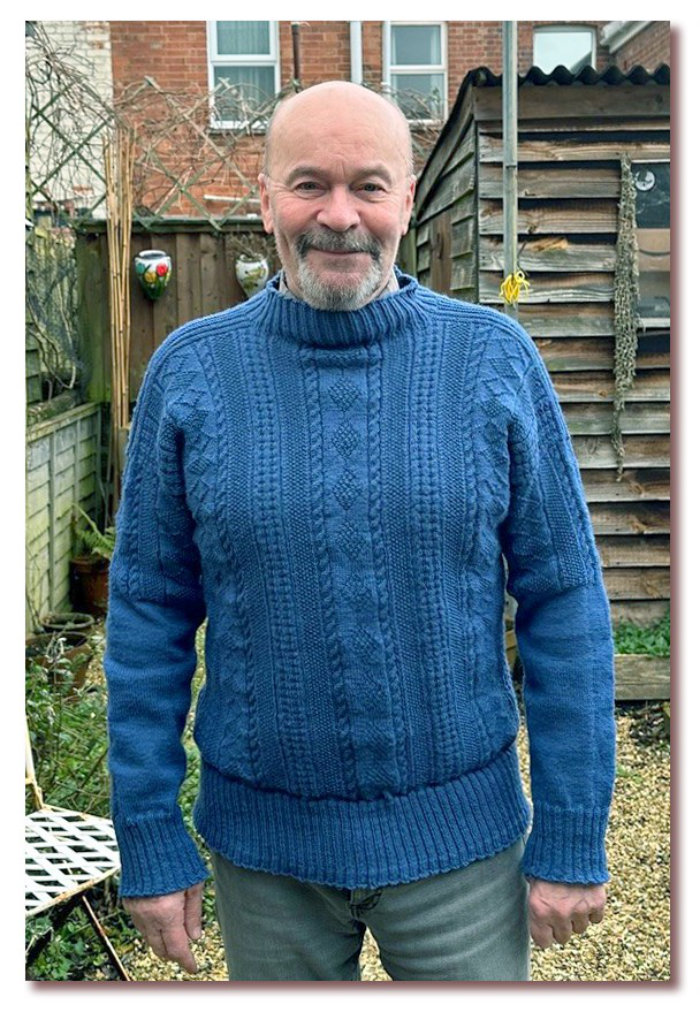
Marion’s last Gansey was yet another Rajiv “Special Commission” while her recent
Flamborough Gansey in the attractive “Helford Blue” colour wool is now proudly
being worn by the novelist Peter Benson, who kindly sent the photograph at right.
Details of Peter’s novels can be found here: Peter Benson
Our longest-serving Knitter
Rajiv Surendra’s excellent video
on the history of the Gansey






Contact Information
Flamborough Marine Limited
The Manor House
Flamborough
Bridlington
East Riding of Yorkshire
YO15 1PD
United Kingdom
Telephone:
01262 850943
International:
+44 1262 850943
E-mail:
gm@flamboroughmarine.co.uk

Few occupations
are more at the
mercy of the wind
and weather than
fishing. And it was
the practical
requirement for
warm yet
unencumbering
clothing that
prompted the
development of a
fascinating
tradition in
fishermen’s
sweaters, variously
known as jerseys,
Guernseys and
Ganseys.
It is likely that the word ‘jersey’, used to describe a knitted garment,
owes its derivation to the name of the largest of the Channel
Islands, where worsted spinning was once a staple industry. Over a
period of time, the close-fitting garments knitted in worsted-spun
yarn made in Jersey, and favoured by sailors and fishermen, became
known as jerseys.
Similarly, the neighbouring island of Guernsey gave its name to the
classic square-shaped wool sweater, which was designed with a
straight neck so that it could be reversed. Gansey, a term which
crops up in the writings of both Samuel Beckett and James Joyce, is a
dialect variation of Guernsey.
Until the coming of the machine age in the nineteenth century, most
industries were small-scale and craft-based. As early as 1589,
however, the invention of the knitting frame by William Lee, a
brilliant Nottinghamshire clergyman, had put into motion the
gradual migration of hosiery manufacturing from the domestic
setting to the factory. The uptake of machines was uneven, with
pockets of the knitting industry, such as the famous knitters of Dent
who made small items on short needles, resisting change for many
years.
The production of heavier gauge knitwear remained a largely
domestic activity until much more recently, with women knitting for
entire families well within living memory. Every village shop would
have boasted a section devoted to knitting yarn, and the market
towns would have had at least one thriving wool shop.
The isolated communities along the rugged British coastline were,
by necessity, even more self-sufficient than those further inland. In
the poor fishing communities, families could ill afford the luxury of
goods imported from the outside world. Women knitted for their
sweethearts, husbands and children. At a time when resources were
scarce, outgrown clothes were passed down and adults’ garments
cut down and remade for children.
Visitors to the Yorkshire fishing ports such as Whitby and Filey and
tiny villages such as Seahouses on the rugged Northumberland
coast, reported seeing women sitting in their doorways busy with
their needles. Never wasting a moment that could be used to earn
an extra penny, women worked late into the evening by the light of
rush lamps, knitting the navy-coloured yarn more by feel than by
eye.
Although the classic Guernsey sweater remained plain (some
Guernsey parishes did, however, have their own patterns), the stitch
patterns used became more complicated the further north the
garment spread, with the most complex evolving in the Scottish
fishing villages. These elaborate patterns came south with the
Scottish herring fleet, as the women folk followed their husbands
down the coast to gut the fish. Thus the pattern known as Whitby
flag is in fact an interpretation of a Scottish design.
Young women, who had received little formal education, would
develop the ability to memorize complicated patterns, which were
passed down from mother to daughter, gathering new variations
with each generation. The garments were made on five or more
needles, often called “wires” or “pins”, so as to be seamless. It was
not unusual for men, too, to knit ganseys. Knitting was a natural
extension of the familiar tasks of making and mending fishing nets,
routine jobs which required considerable dexterity.
Tightly knitted in worsted yarn the fisherman’s Gansey was virtually
wind-proof and water-proof. As these working garments were rarely
washed, there is no doubt that a layer of filth would have added to
the general protective effect. It is consoling to learn that fishermen
had “Sunday best” Ganseys which, being decidedly more fragrant,
were worn for church and on high days and holidays.
Many venerable Ganseys appear in the sepia toned photographs
taken by the well-known Whitby photographer Frank Meadow
Sutcliffe from 1880 to the turn of the nineteenth century. Prints
made from Sutcliffe’s original glass plates provide a fascinating
insight into the clothing of ordinary working people.
The characteristic, almost tubular, shape of the fisherman’s Gansey
was dictated by practicality. The welt, neck and cuffs were knitted
tight so as to keep out winter blasts. According to hearsay, so tight
were the Ganseys knitted for the unfortunate children of one
fisherman that, when the garments were pulled over their heads,
the children’s ear lobes bled.
The cuffs, also made to be close-fitting, generally ended short of the
wrist to avoid impeding the hands and becoming soaked with sea
water as the men worked. The close fitting design also helped to
reduce the chances of the hem or cuffs becoming caught on pieces
of equipment or tackle, a mishap which could prove fatal
As time took its toll on the cuffs and elbows, the lower half of the
sleeves could be unravelled and re-knitted with new yarn. Garments
made in various shades of blue, ranging from deep navy to a hue
faded with age, were a common sight.
The upper part of the body was knitted more densely than the lower
part to provide extra warmth, and it was on the yoke and upper
arms that the knitters had the opportunity to show off their knitting
skills and to elaborate on the basic stocking stitch with numerous
variations.
For detailed records of the many local interpretations of traditional
fishermen’s jerseys, we are indebted to the tireless efforts of Gladys
Thompson, who, in the 1950s, pencil and paper in hand, scoured the
fishing ports on the east coast—from Sheringham and Cromer in
Norfolk as far as Upper Largo in Fife.
Her quest, fired by a determination to preserve for future
generations patterns which were seldom written down, took her
down the narrow harbour ginnels (passages) and into the cramped
fishermen’s cottages, where often a single room served as kitchen,
bedroom and living room, with an attic above for storing and
mending nets.
On one occasion Gladys Thompson describes how, on the track of
two knitters who lived on Holy Island, she hired a young lad to drive
her across to the island from Berwick. He arrived in a car at least
thirty years old and covered with rust and sand. Their journey, made
before the causeway linking the island to the mainland was built,
entailed driving through the sea which surged into the ancient car
through the floor boards.
Many of the stitch motifs used to decorate the Ganseys were
inspired by the everyday objects in the lives of fishing families. Some
of the best-known designs represent ropes, nets, anchors and
herringbone. Other patterns are based on the weather, echoing the
shapes made by waves, hail or flashes of lighting. Some patterns
had more complex symbolic meanings. One of the traditional Filey
patterns, for example, is a zigzag design called “marriage lines”
which represents the ups and downs of married life.
It was even possible for fishing families to recognize from the
pattern of a Gansey, which fishing village, or even which family, the
wearer came from. At a time when the loss of a boat was a frequent
occurrence, deliberate mistakes or the wearer’s initials were often
incorporated into the design in order to help to identify a body
recovered from the sea. As the Gansey was was traditionally worn
tight-fitting and close to the skin, and with no seams to come apart,
it could not be washed off in the water.
By tradition, the sweaters worn by all kinds of seafarers, whether
they be fishermen, naval or retired sea salts, are navy blue—a colour
reflecting the sea and sky. Before the advent of synthetic dyes in the
late nineteenth century, blue was obtained by using natural indigo, a
plant extract imported from India. However, summer weight
Ganseys, knitted in a three- or four-ply yarn rather than the usual
five-ply, were sometimes pale grey or fawn.
In a world which is becoming increasingly global in popular culture,
the preservation of our traditional craft takes on a fresh urgency.


A Vintage Gansey
The print above, showing a fisherman running through the streets
of a small northern fishing village shouting "All hands man the Life-
Boat!" is dated 26 November 1887. The fisherman is clearly
wearing a Gansey which, upon closer inspection, is almost certainly
that of the Cullercoats Rocket Brigade.
Over a century later, the same pattern can be knitted, and in the
same method, all-in-one piece, on five needles, in the finest quality
5-ply worsted wool. If the fisherman returned today, he would find
a few things still familiar in Flamborough, and much that was alien.
The fishing boats (known locally as "cobles") would still be instantly
recognizable, as would Flamborough lighthouse and, if he walked
into the premises of Flamborough Marine, upon my soul, he would
find a match for his own Gansey.
A Unique Garment
The photograph at left shows Jack Cross of Flamborough mending his pots. The photograph was taken shortly before Jack and his two eldest sons were drowned at North Landing, Flamborough on Friday 5 February 1909 while trying to land their catch in a gale. The photograph was kindly donated by the third son, the late Mr Edward Cross, who is the small boy standing in the cottage doorway behind his father. Old sepia photographs evoke the romance of far-off times. Yet there was little romantic in the life of a North Sea fisherman at the turn of the century when most days involved a struggle against the elements. Life could be just as hard for the womenfolk. Days were long but, in addition to such essential tasks as baiting the lines, time would be set aside for Gansey knitting, either for members of the immediate family or else for sale to raise a few extra shillings. Great pride was taken in this knitting, especially for the ‘Sunday best’ Gansey (often not in the traditional navy) to be worn at such occasions as the Flamborough sword-dancing or Filey fishermen’s choir, both of which still thrive today. At some time past the custom arose that each fishing community would have its own identifiable pattern based on a selection of motifs related to the sea: nets, ropes, ladders, herringbones, and so on. Although it is now impossible to ascertain precisely when the patterns came into being, this style of knitting originated during the reign of Elizabeth I and the patterns were fixed by the beginning of the nineteenth century. This means that it is possible to tell where a fisherman came from by the pattern on his Gansey; it is also the factor which, more than anything, makes the Gansey unique. Eventually, however, the craft of Gansey knitting went into steady decline as younger people moved out of the fishing villages and was in danger of dying out completely. Each Gansey is a living part of history and we believe it is essential that the craft is maintained and nourished. Every Gansey tells its own story. This was originally for a very practical, if morbid, reason. As each village fishing community could be identified by the design on its Gansey, if the body of a fisherman was found it could then be returned to his home for burial. In larger fishing communities, small alterations to the basic pattern could even allow for the differentiation of families within that village. Indeed, it is perhaps not too great an exaggeration to say that Ganseys helped foster the community spirit. Today that spirit is alive and well and Ganseys are still being worn, not only by those who work in them, but also by those who appreciate the workmanship, history, and beauty of these remarkable sweaters. Note that the patterning is the same, back and front. This means that the Gansey is reversible, so that areas which come in for heavier wear, such as the elbows, can be alternated. Traditional ganseys are knitted in the round, apart from the chest and back, which are knitted back and forth on two needles before being joined at the shoulders. They are a snug fit; a baggy sweater would be a liability on a fishing boat. The fake “side seams,” usually just a row of purl stitches at the sides, serve to keep the knitter on track. They are where adjustments can be made in size, without compromising or interfering with the main pattern.

Flamborough Marine
Your source for authentic
hand-knitted Ganseys and
Gansey Knitting Kits
We pride ourselves on our personal
attention to detail. If you are at all
unsure about any aspect of our
products, telephone, write or e-mail
us with your query which will be
answered promptly and, we hope,
knowledgeably. We wish to ensure
that you are completely satisfied
before making a purchase, as well
as after.
This is the mobile variant of our web-site, specially designed for
viewing on smartphones, but lacking some of the more
detailed information available on our full-size site.
Flamborough Marine
The Manor House
Flamborough
Bridlington
East Riding of Yorkshire
Telephone 01262 850943


