
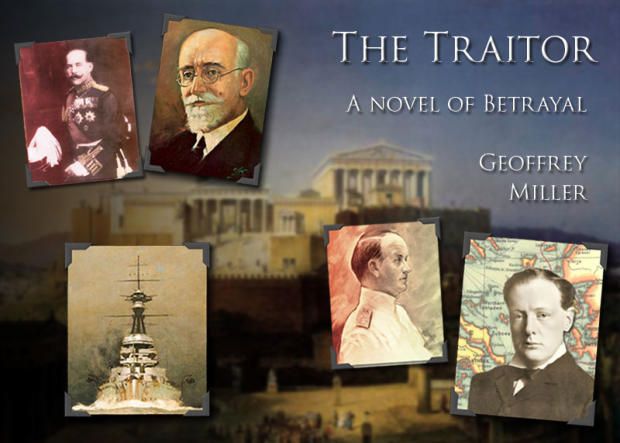
The first six chapters of “The Traitor” are
available to read on-line.
Copies of the book can be purchased from
LuLu.com : ISBN 978 1 4092 9076 6
Based on “Superior Force” the acclaimed
study of the escape of Goeben and Breslau

Please feel free to read
this novel but note that
all rights are reserved
and that no part of this
publication may be
further reproduced by
any means without the
prior permission of the
author, Geoffrey Miller,
who has asserted his
right in accordance with
sections 77 and 78 of the
Copyright, Designs and
Patents Act, 1988 to be
identified as the author
of this work.










Contents and Design Copyright 2015 Geoffrey Miller






Contact Information
Telephone
01262 850943
International: + 44 1262 850943
Postal address
The Manor House,
Flamborough,
Bridlington,
East Riding of Yorkshire, YO15 1PD
England.
E-mail
gm@resurgambooks.co.uk

Chapter 1
The Disappearance
Lionel Samson gazed intently in the signalling mirror; the face which stared back incomprehensibly was not his.
It was the face of a middle-aged man, burdened by the knowledge of a wasted life. This was curious as Samson
did not feel in the least middle-aged — indeed, he felt inwardly no different now than when he had been in his
twenties — and he did not, at least on the surface, believe that his life had been wasted. The reflection, however,
told its own story; and reflections, although occasionally capricious, by their very nature, do not lie. The
realization that his years had caught up with him was the final, bitter, blow; for Lionel Samson also now knew
that you only had one chance of happiness; when the opportunity presented itself, it had to be snatched selfishly
and damn the consequences for anyone else. And this he had failed to do. Not that he entirely blamed himself; for
the problem remained how to recognize the opportunity when it did present itself? What if, having followed one
course of action in the reasonably certain knowledge that the path ahead was the correct one for the attainment
of true contentment, another, seemingly more inviting path, suddenly appeared? How could he know when he
was truly happy, and that there was not greater satisfaction to be found elsewhere? The final irony was that
Samson had long refused to believe in pre-ordination, and now it had come to this. One by one the chances had
multiplied until the succession of accidents, coincidences and improbabilities could not be described as anything
other than fate; and at every point where he had had the opportunity to choose — for example, in South Africa in
1901 and Syria in 1911 — he had usually taken the wrong turning. Only at Ephesus, in that magical late summer of
1912 which now seemed an eternity ago, had he chosen correctly and then fate once more, for there was no other
explanation, had intervened. From that point, not yet two years ago, all the minor turnings seem to have pointed
him in one direction and, with it, a chance at redemption. Not, he would hasten to add, redemption for past sins;
but redemption for the wasted life now revealed to him in his reflection. He owed, or so he believed, nothing to
anyone, except himself; it was, and always had been, a personal odyssey.
Since Major Samson’s one and only stay, in October 1912, just enough had been spent on the fittings of the Hotel
Berlin in Smyrna to guarantee it’s inclusion in the latest Baedeker. The effect, however, was transparent, and as
shallow as the thin layer of civilization which covered, but did not succeed in hiding, the swirling undercurrent of
corruption, misery and lost hope endemic to the city. With the outbreak of the Balkan War that month,
immediately after the signing of the Peace Treaty with Italy (Turkey’s enemies were lining up enthusiastically
against her), throughout the latter part of 1912 the large Greek population in Smyrna lived in constant fear of
their Turkish masters. A Turkish victory, which the long-time Greek residents, who had little in common with
their compatriots in Athens, secretly prayed for, would have eased their plight; the inevitable Greek victory,
however, reduced to them a state of constant foreboding. For Fakhri Pasha, the Vali of Smyrna, the continued
presence of the Greeks represented a conundrum he could well have done without, for the Greeks controlled the
financial well-being of the city. Any orchestrated reprisal against them might bring the city to a standstill, yet
Fakhri had to do something to appease the hot-headed District Military Commander, Djaved Bey, for whom
action against the already persecuted Greeks was a soft option but one which would help to expunge the shame of
the Turkish defeats in Macedonia and Thrace. As resourceful as ever, Fakhri found his answer by punishing the
Greeks in the most effective manner possible: to help finance the Turkish war effort, Fakhri announced the
imposition of a special tax whereby shopkeepers were compelled to give one particular day’s takings, to be
decided at random, to the Ottoman Naval and Military Fund. Already guaranteed to fall most heavily on the
Greeks, who owned most of the businesses in Smyrna, the tax was made more onerous still as, on the day
appointed for his compulsory contribution to the scheme, the Greek shopkeeper would find that word had been
mysteriously spread that all that day’s income would go to the local Treasury (or Fakhri’s pockets, for they were
more or less the same thing). Any establishment unfortunate enough to have Greek owners would then find the
premises invaded by crowds of Moslem customers who proceeded to buy out the entire contents.
The owner of the Hotel Berlin, Monsieur Gryparis (a distant, or more accurately a very distant, relation of the
Greek Minister in Constantinople), lived in dread of a similar ploy being worked against him. Every precaution
which could be taken had been taken. Djaved’s officers regularly and ostentatiously used the Hotel, at no charge,
for their assignations, to the obvious disgust of the foreign guests. The staff were, almost to a man, Turkish — a
source of constant complaint from his guests because of their idleness (why should they work hard for a Greek?),
and of constant irritation to his fellow Greeks for the bad example it set. But, Gryparis would argue, what could
he do? Every other concession to passing whims had been made; even the name of the establishment reflected
the current international situation. Four years previously, when the Sultan had been overthrown and the
Constitution had been restored, when Britain had been the great friend (or so it had seemed) of the new régime
in Constantinople, had he not changed the Hotel’s name from the "Grand" (which, for some unfathomable reason
provoked mirth amongst the clientele) to the "Hotel Great Britain"? And when, within two years, British support
was found wanting, British tourists remained thin on the ground, and the Kaiser spoke those wonderfully
supportive words, did he not then change the name again, to its current incarnation, the "Hotel Berlin"? A more
cynical observer might have argued that the latest change of name had more to do with Herr Baedeker’s decision
not to publish an English-language guide to the region — the latest edition of Konstantinopel und Kleinasien
would again only be available in German. Business, Gryparis would complain frequently, was nothing but a
constant source of concern. If this was not all he had to worry about, there was also the disappearance of the
Englishwoman to contend with. Guests who disappeared without genuine cause were not good for business.
When Major Samson insistently demanded to see Monsieur Gryparis just before midnight on that October
evening he was in such a state of suppressed nervous tension that Gryparis, who initially appeared at the desk in
an irritable mood, expected at any moment to have to summon a doctor for his guest. It was so unlike the
English, Gryparis mused, to let their emotions get the better of them. Voluble emotions were better suited to a
nation which could accommodate them — such as the Greeks, although Gryparis had been too long as a hotel
keeper to want to bother with such things. Emotions were bad for business; and so were scenes.
‘Calm yourself, Monsieur!’ he demanded of the English Major, ‘If the lady has not returned, there may be a logical
explanation. How is it you came to be separated?’
The Major, who had been so distressed a few moments previously had reacted instantly to Gryparis’ command
and now seemed intent on the small placard hanging just behind the Manager’s head; "M. Gryparis, the
Proprietor of the Hotel, hopes to justify the confidence placed in him, by a carefully arranged system of prompt
and civil attendance, combined with moderate charges."
Samson’s stare was so fixed that Gryparis was forced to turn around and read the sign for himself although he
knew it by heart. It meant, in any event, nothing to him. He had noted it hanging in one of the better hotels in
Constantinople, when he was there in 1910, and had had a copy made for his own establishment. Now, however,
in view of the Major’s obvious distress, he felt obliged to live up to it: he guided Samson gently away and into his
private office. Uncharacteristically, Gryparis fumbled over the oil lamp, his nerves betrayed by the position in
which he found himself. Despite his best efforts to be the master of all situations, he was still (privately) in awe of
the English. Such nervousness would soon be quelled as M. Gryparis, having seated the Major, himself settled
behind his imposing desk. The desk itself formed a major part of the manager’s life and, as such, it reflected his
personality more than did his outward physical appearance or his otherwise modest lodgings. M. Gryparis
enjoyed the latest paraphernalia; or, as an American guest had recently referred to them, ‘gadgets’. Gryparis
spent his infrequent off-duty moments buried in the thick and strangely comforting tomes which lined the small
bookshelf at his side: Gamages General Catalogue, the Army and Navy Stores Catalogue (both a gift from Mr
Eldridge, the estimable English Consul-General), the Prisunic compendium, and the guides to the latest wares
from Berlin.
Gryparis would select a volume at random, open it at random, and idly turn the pages until he had discovered
something he must have. Then he would replace the volume on the shelves and convince himself that the last
thing he needed was another ‘gadget’. This procedure lasted anything from a few days to a few weeks; at which
point he would send for the item. The expectation which preceded its arrival was delicious, until the moment
came at which the parcel was presented to him. And then, invariably, he would tear at the packaging, examine the
item minutely, and wonder why he had been so stupid as to waste his hard-earned money on such a thing.
In the awkward silence which immediately followed Samson’s admission into his inner sanctum, it occurred to
Gryparis that, if their positions had been reversed, the Major would have offered him something to drink. Even if
the Major desired nothing, the put-upon Manager needed one himself. Samson took the glass offered and silently
watched, with consuming interest, as Gryparis filled it well past an ordinary measure; it was, the Manager
thought to himself, just as well he had not opened his best whisky. Samson took a few sips, then a gulp, coughed
hoarsely, and put his half-finished drink down.
‘Now, Major Samson,’ Gryparis ventured, ‘can you tell me more so that I may try to help? The lady … was not
your wife?’
Samson observed the diminutive, finely sculpted form of the Manager closely for the first time. In the concerned
expression he noted a combination of lingering annoyance at being disturbed, mingled with curiosity as to the
facts behind the mystery. Samson took another sip of his drink; it tasted sour now and it was with some difficulty
that he avoided retching. His problems were not the Manager’s. There was nothing for it but to go to his room
and commence the search anew at first light. He rose unsteadily: ‘I am sorry, Monsieur, for the disturbance; it is
a personal matter.’
Gryparis, his irritation now dissipated, spoke soothingly: ‘Please, Major Samson, be seated. If you will forgive me,
I know what it is like to lose something one has loved. Look at my life here — it is ordered so that from one
minute to the next I know what is to be done. The Turks mock me, of this I am aware. "There goes Gryparis,
always busy, always occupied, always interfering … " But it is thus for a reason. While I am busy I cannot think.’
Samson again looked thoughtfully at Gryparis, little knowing that the object of the Manager’s affection, and the
cause of both his unhappiness and his subsequent devotion to duty, had been a member of a travelling
Roumanian "theatrical" troupe who, fancying herself as the manageress of such a fine establishment, had pledged
her undying love. Although aware of her real profession, Monsieur Gryparis was completely under her spell and
ready to make the greatest of all sacrifices — his business — when the dancer met, by chance, the Italian aviator
who had crash landed his waterplane in the Bay and had been the subject of headlines for days on end. At that
time, the Spring of 1912, most of the fighting with Italy had ceased, but the war was still fresh in Turkish
memories and, suspecting a new move while the peace negotiations were about to commence in Lausanne, the
Italian was fortunate to escape with his life once word had got around of his nationality. Fakhri Pasha needed all
his powers of persuasion to convince the mob which had gathered that the Italian was an innocent flyer of
peaceful intent, for whom (although Fakhri kept this to himself) a large ransom might be offered if repatriation
could be speedily arranged. How, precisely, the Italian aviator had encountered the Roumanian was not, even
now, clear to Monsieur Gryparis. What was clear was the Italian’s conspicuous wealth and better prospects — so
long as he remained on the ground; however, the chance that he might soon come to an untimely end while still
encumbered with his fortune clearly weighed heavily on the lady, who would have to wait some considerable time
before acquiring the much smaller capital of M. Gryparis.
The Manager had told himself again and again that she was worthless and had come close to admitting as such.
What he could not accept, however, was the sense of betrayal and, more than that, of rejection. The attention he
had lavished upon her was well known; for months afterwards, wherever Gryparis ventured, he fancied that
whispers accompanied him: Gryparis the unfortunate, Gryparis the deluded, or — most apposite — simply,
Gryparis the fool.
For the first time that evening aware of a kindred soul, Major Samson relaxed slightly. He lifted his glass to his
lips and then thought better of it and put it down. ‘In my time,’ he began slowly, ‘I have known death (too much I
warrant); and sorrow, perhaps enough to last a lifetime; fear, more often than I care to admit (for I am not a
brave man); fulfilment, yes — even happiness occasionally, but love … ’ He fixed Gryparis with an unnerving
stare: ‘Have you ever loved someone so completely that your own life, your very existence, means nothing?’
Gryparis nodded — not that it was an analogy he, himself, would have used, but he could understand the
sentiment. ‘I have,’ Samson continued, ‘the reputation of being cold and uncaring. It is surprising how many truly
romantic souls wish to convey that image. You perhaps wouldn’t think it to see me now in this state. Oh, I’m well
aware that at my age I should know better …’ (Gryparis winced), ‘but it is precisely because most of my life has
passed by with nothing to show for it that I … that we … ’ Samson choked momentarily on the words. ‘If the
chance presents itself and may never be repeated … Do you see? What good would it do in ten years’ time to look
back and say, "I could have possessed her, but it was for the best"? There comes a time when it is necessary to
admit that certain ends require certain means. Time is our enemy, don’t you see? We might have met a decade
ago, when the lady was still free …’
‘Ah,’ Gryparis interrupted, ‘so the lady is married.’
‘A loveless charade. Oh, there might have been a spark of passion early on — there must have been on Edith’s
part; it is her nature. But Roberts …’ Samson’s voice trailed off.
‘Guilt is a powerful emotion, is it not? And then there is the question of reputation. It is something upon which
you English place a high value. I am sorry to suggest this, Major, but is it not possible the lady has perhaps
returned to her husband?’
Samson struck the desk: ‘Never! Of that I am sure. That is what makes this all so unbelievable — I was sure. I am
sure. We would never have talked as we did, we would never have conducted ourselves as we did, had I not been
absolutely convinced it was what we both wanted. I have spent half my life in pursuit of what I am now to be
denied. I shall spend the rest of my life regretting it — unless I can find her.’
‘Where did you last see her?’
‘She was going to meet the Constantinople steamer this afternoon — her husband was on board. We were to meet
this evening to discuss matters.’
‘A civilized arrangement …’
‘A formality! Roberts had paid scant attention to her in the past few months — it was clear that only habit, and a
love of archaeology, kept them together.’
‘Could some fate have befallen the gentleman in Constantinople? A rich Englishman travelling alone?’
‘Money has little meaning for him, except when it assists his work. Roberts is not rich and has none of the
outward trappings. Besides, he has friends in high places. I cannot answer for Constantinople, but he certainly is
protected in this district. Before digging commenced a deal was struck with Fakhri Pasha that half of the best
finds uncovered at the site would become the property of the Vali.’
Gryparis jerked forward abruptly at the mention of his persecutor. ‘Then I can have little sympathy for your
friend. Too many treasures …’
‘But you are Greek …’ Samson interjected.
‘It matters not. These treasures belong to civilization.’
‘It was the only way to obtain the permit. Even then Fakhri needed concurrence from the Minister.’
‘You have not mentioned this before. Perhaps the authorities in Constantinople learned of the deal? The Minister
of the Interior has the reputation for being incorruptible. Of course, with his wealth, it is a luxury he can afford.
Could Hakki Pasha have detained your Mr Roberts in Constantinople?’
In his agitated state, Samson had not considered such a possibility. ‘Hakki had already kept him there two days
longer than planned. But even if you are right, why would Edith not have returned here once she had established
he was not on board?’
‘Perhaps …’ Gryparis checked himself.
‘Yes?’ The Manager remained silent. ‘You suspect something?’ Samson demanded.
‘Forgive me, Major, it is just this — what if the steamer was not coming to deliver the husband, but to collect the
wife? Since the law of 1910 all treasures, no matter how trivial or apparently worthless, must be reported, and
belong to the State. It is a serious crime not to comply. If your Mr Roberts was unable to convince the authorities
that he has adhered to the law strictly, perhaps Hakki summoned his wife. To threaten a man is one thing; to
threaten a lady another. A refusal to admit the truth would not be so forthcoming if the gentleman knew that
Hakki was next to interview his wife. I have no wish to alarm you, Major, but if what you say is true, that the lady
would not have returned voluntarily to her husband, and that he would not have forced her to return against her
will, there are very few alternatives. You have contacted the police here?’
‘There are no reports of anything untoward.’
‘Then there is nothing you can do now, my friend. Believe me, the mystery will be solved and, when you know the
solution, it will turn out not to have been a mystery at all. Go to your room now and we will begin afresh in the
morning.’
The setting sun struck the mirror at an oblique angle, blinding the Major for an instant. Once his eyes again
became accustomed to the fading light he looked out over Rusa Bay. His nemesis was still there.