
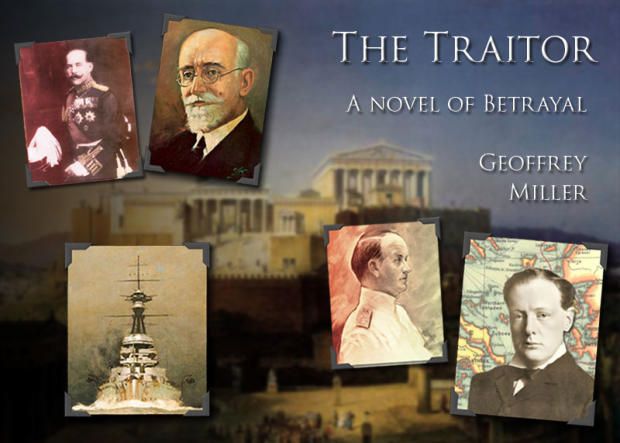
The first six chapters of “The Traitor” are
available to read on-line.
Copies of the book can be purchased from
LuLu.com : ISBN 978 1 4092 9076 6
Based on “Superior Force” the acclaimed
study of the escape of Goeben and Breslau

Please feel free to read
this novel but note that
all rights are reserved
and that no part of this
publication may be
further reproduced by
any means without the
prior permission of the
author, Geoffrey Miller,
who has asserted his
right in accordance with
sections 77 and 78 of the
Copyright, Designs and
Patents Act, 1988 to be
identified as the author
of this work.










Contents and Design Copyright 2015 Geoffrey Miller






Contact Information
Telephone
01262 850943
International: + 44 1262 850943
Postal address
The Manor House,
Flamborough,
Bridlington,
East Riding of Yorkshire, YO15 1PD
England.
E-mail
gm@resurgambooks.co.uk

Chapter 5
The Enchantress
The Simplon Express hastened through the night past dark, somnolent towns and villages, and fields of
murmorous wheat whispering secrets in the breeze. Apart from a short stop in Paris, where they had had a hurried
meal at a favoured café, the Prime Minister’s party had been imprisoned in the train for twenty-four hours so that
it was with more than unusual anticipation that they stepped on to the platform at the Venice terminus. The late
afternoon heat of an unseasonably sultry May struck them almost forcibly as they emerged from the relative
coolness of the station. Ill-served by their heavy London clothes they brushed past the Hotel touts, longing to
reach the sanctity of their destination. Out in the Lagoon Enchantress, the Admiralty yacht, moved gently at her
mooring. In such a setting as this there seemed little point in tugging vehemently at the ropes. With her elegant
black hull, white upperworks and raked ochre funnel she resembled a miniature version of a turn-of-the-century
cruiser (before the hated edict had been imposed by which grey became the uniform colour of the fleet). The
faintest wisp of smoke emerged from her funnel and spiralled perpendicularly in the still air.
Making their way from the station to the pier, the party took in the sights, sounds and smells of Venice, but only in
a perfunctory, nonchalant way; something more important was on their minds. A chance to escape the cares of
office. For three precious weeks the P.M. could put away his dispatch box and pick up his Baedeker and Murray’s
Guide. The eighty crew aboard Enchantress would be at his beck and call; they were free to roam the Adriatic to
their hearts’ content. The only member of the party who appeared even the slightest degree anxious was Winston
Churchill for he had not, at the station, been able to obtain the latest edition of The Times and was now fretting.
Noticing his discomfiture, Violet Asquith, the P.M.’s twenty-six year old daughter, could not help but tease him.
‘No newspapers for you till we reach Athens. The world will pass you by for a fortnight,’ she giggled.
‘I shall have the Captain wire for the latest news,’ Churchill announced pompously.
‘That,’ Prince Louis interceded sternly, ‘would be an improper use of wireless telegraphy.’ Even Churchill joined in
the amusement at the First Sea Lord’s rectitude.
Once their copious luggage had been stowed away and the official party had been introduced to the officers,
Asquith immediately retrieved his battered copy of Thucydides, found a shaded spot on the deck and sank back in
the canvas chair provided. He was soon joined by his wife and daughter; Clementine Churchill and Lady Randolph
Churchill; James Masterton-Smith from the Admiralty; and Eddie Marsh, Winston’s private secretary. Prince
Louis was renewing an old acquaintance and could be found on the bridge. The only absentee was Churchill.
Noticing his absence, Asquith wondered for a moment whether it would be better to leave the First Lord in peace,
which invariably meant peace for himself as well. Eventually however, curiosity got the better of even this most
incurious of politicians.
‘Eddie, is Winston not interested in our departure? To see Venice from the sea is, I am told, an incomparable
sight.’
Marsh, comfortably ensconced in his own chair, was loathe to move but could not ignore such an entreaty: ‘I’ll find
out where he is P.M.’ At which, with surprisingly lithe and easy movements, Marsh bounded down the companion-
way, along the panelled corridor and tapped lightly on Churchill’s cabin door. There was no answer. Marsh
knocked again, even more gently, hoping Winston might be having his usual afternoon nap. He was just on the
point of returning to the deck when:
‘Enter!’ Marsh did no more than put his head through the door. The portly figure which greeted him was propped
up on the bunk, an open dispatch box at his feet, and papers strewn all around.
‘First Lord, we are just about to depart. The P.M. thought …’
‘Not now, Eddie. I am making notes on the world’s supply of oil. Fisher’s Royal Commission got it all wrong you
know. The Gulf is not safe from Russian encroachment; we need a pipeline from the fields in Persia and
Mesopotamia straight through to the Mediterranean.’ (Marsh knew that this had originally been Fisher’s
suggestion, but said nothing.) ‘It will mean bribing the local tribes to protect the pipeline, but that can be done.
That’s what we need. I shall require you later to take some notes, once I have the broad outline clear in my mind.’
Marsh, who at that precise moment did not care who controlled the world’s supply of oil, cursed Asquith privately
for this, and returned, sullenly, to the deck.
‘Well, Eddie?’ Asquith inquired politely.
‘The First Lord is working out how to keep our oil to ourselves, safe from the Russians.’
Clementine Churchill, for whom such behaviour was an everyday occurrence, raised a silent eyebrow, then buried
her head in her book, lifting it again only when Violet Asquith cried out: ‘Look, we’re moving!’ As she spoke
thunder reverberated in the distance; a few drops of rain splashed on the water, the ripples from which further
calmed the already placid sea. The temperature plunged as the sky darkened; one remaining shaft of sunlight,
illuminating the now grey water, closed reluctantly as the rain became more insistent. Within minutes the
downpour had become a torrent, forcing them all into the saloon from where they watched silently as the veil of
rain obliterated Venice.
Once under way and out of sight of land, even Winston joined in the spirit of things; the question of oil supply for
the navy could wait. As they were more or less guided in their cruise by naval men, to whom discipline is
everything, a pattern of sorts began to emerge. After a morning’s steaming always within sight of the barren coast,
they would drop anchor. Then, at a secluded cove the party would take to the boats, row towards shore and swim
in the undisturbed sea. Thereafter followed a picnic lunch on the beach; then a nap, until finally, as the sunlight
turned lazy and mellow in the late afternoon, the row back to the yacht. For the first few days they made
deliberately slow progress. Their own small world was completely self contained; even Winston’s threat to
monopolize the wireless had not materialized. Their first contact with the outside world did not come until the
fourth day when they dropped anchor off the ancient port of Spalato[1]. The P.M., with the constant need to
display his erudition, had boned up on his history the previous night and was able to offer a guided tour of
Diocletian’s Palace courtesy of Baedeker. The small group followed him around attentively, marvelling at his recall
of events.
‘Oh, Winston, isn’t it marvellous,’ enthused Violet Asquith.
‘I should like to bombard the swine,’ muttered the First Lord cryptically, his thoughts clearly elsewhere.
They were all conscious, nevertheless, that the country always off the port side — Bosnia —was wild and desolate,
with only a thin veneer of civilization beneath which lay unimagined horrors. If one looked at the large map in the
ship’s library, the whole coast as far south as Cattaro was coloured in the same shade as Austria-Hungary; and, if
one thought of Austria-Hungary, one thought of the sybaritic delights of Vienna. However Bosnia had been a
recent acquisition: still nominally Turkish, its formal annexation by Vienna five years previously had come close to
plunging Europe into war. The Austrians had, as always, been heavy handed, a failing which continued to the
present day: the simmering unrest amongst the local populace did not, however, go unnoticed by the more astute
observers on board Enchantress.
Southwards, they sailed, ever southwards until, as they neared the sight of some of the recent fighting in the
Balkan War, Violet noticed a marked change in Winston. The gradual softening of his demeanour once they had
left Venice disappeared to be replaced by a longing for martial action. Violet remained fascinated by Winston’s
moods. As they leaned on the rail admiring the view, the First Lord of the Admiralty could be heard calculating the
range, commenting on the perfect visibility, and bemoaning the fact that Enchantress carried no weapons. ‘If only
we had got some six inch guns on board, what wonderful shooting we could have,’ he declared to no-one in
particular.
At Ragusa,[2] the next port of call, the anchor noisily rattled down into the crystal water of the precious harbour.
So still was the water that it appeared, for an instant, as if the anchor would shatter the shallow sea. Silver fish,
which had collected around the keel, turned in unison and fled, glinting, towards the sea wall before venturing
timidly back. Once ashore, while Asquith, Clementine and Masterton-Smith explored the churches and ancient
buildings, the others set off to circumnavigate the outer wall. Sheltered from the worst excesses of the weather,
oleanders, agaves and palms flourished outside the wall, while, inside, the uniform stone work and terracotta roofs
added to the air of unreality. Returning to Enchantress for lunch, they could not bear to depart that afternoon.
Instead, captivated by the locale, the party decided to motor inland to Trebinje. Two vehicles were eventually
produced, the property of the Majestic Hotel in the new part of town, further along the coast. Although the English
party would not be staying with him, the owner was nevertheless delighted that such an exalted group of foreign
dignitaries should avail themselves of his new motors. Since buying them the previous year his wife had never
stopped haranguing him. What use are they, she would taunt, in a country with so few roads? Now he would show
her: people would come to view the car in which the British Prime Minister had travelled.
Motor cars were still a rare enough sight in Trebinje to cause intense excitement. As they drove up the narrow,
dusty main street, desultory groups of Bosnians turned to stare, and were stared at in turn. Their costumes,
unchanged since the days of the Turk, varied from one to another: baggy black breeches, silk tassels and distinctive
flat red fezzes or sleeveless jackets and tight breeches with high, white fezzes. The gaudiness of the costume,
someone in the front car shouted above the noise, apparently denoted status within the town: the poorest of the
poor could be easily distinguished by their uniform of unbroken white. Colour remained the preserve of the better
off. Weapons were also everywhere: ancient rifles, which appeared as if they would present a greater danger to the
user; pistols, incongruously decorated with seed pearls; and the ubiquitous, unsettling scimitar. Asquith, who by
now had committed large sections of Murray’s Handbook for Travellers to memory could not refrain from quoting
Dr Arnold: ‘The eastern coast of the Adriatic is one of those ill-fated portions of the earth which, though placed in
immediate contact with civilization, have remained perpetually barbarian.’ As he finished, the car was shaken by a
severe jolt and the P.M. was launched bodily into the air. Please click to go to the top of this page
‘Henry,’ his wife pleaded, ‘not so loud. Someone may hear.’
‘But my dear,’ he reasoned as she looked nervously around, ‘there will be no English speakers within miles of this
place. And I shall say what I like.’ At that, the car hit another ditch, with the same result as before.
‘I told you so, Henry!’ Margot invariably had the last word.
The dust thrown up by the car had covered the occupants in a fine layer; it lined their nostrils and their throats so
that it was with some relief that they stopped at the Hotel Vuko Velitic for refreshments before commencing the
return journey to Ragusa. From Trebinje it was possible to reach Cettinje, the capital of Montenegro, and Winston,
eagerly joined by Violet Asquith, suggested that they should visit that city also. The suggestion met almost
universal disapproval. The countryside was certain to be roaming with brigands; their small escort could easily be
overcome; the situation in the region was still too fluid. Indeed, the Montenegrin Army was, at that very minute,
evacuating (or, at least, that was how King Nicholas would describe his army’s action, for, in reality, they were
being forced out by the pressure of the Great Powers), evacuating the key strategic town of Scutari in adjoining
Albania, which the Montenegrins had “purchased” from the commander of the Turkish defenders, Essad Pasha.
With Turkish forces throughout Europe being beaten back by the Balkan Allies, Essad Pasha, realizing that his
forces could not withstand the siege much longer, decided that any capitulation might as well enrich his own
pocket.
When he heard of the deal, through Montenegro’s garrulous, indiscreet representative at the Ambassadors’
Conference in London, Sir Arthur Nicolson could scarce believe it; still, that was the way business was conducted
in these parts. The creation of an autonomous Albania on Montenegro’s southern border had been the only
tangible result to date of the Ambassadors’ Conference. But while everyone was agreed that the new state should
be created, no-one could agree on its boundaries. Greece, Austria and Italy were all currently engaged in a tug-of-
war over the unfortunate country, each determined that the new boundary should be drawn so as to favour their
own territorial aspirations in the region. In a forlorn attempt to prevent complete anarchy, an International
Brigade of ships was, at that moment, anchored off the Dalmation coast, near the port of Antivari.
Asquith, if he thought of these matters at all, could content himself with the knowledge that it was now all in the
capable hands of his Foreign Secretary. This was the penalty Grey had to pay for his refusal to travel. The irony of a
Foreign Secretary who positively hated all foreign travel had never occurred to Asquith. All the P.M. had on his
mind at that moment was a swift return to Enchantress and a bath to dissolve the dust. At dinner that night on
board, after Masterton-Smith, the most gifted classical scholar in that gifted entourage, had expounded on the
events which had occurred in the vicinity two millennia previously, Asquith leant forward, signalling to the
company that he required their attention. As the evening wore on, the P.M.’s utterances had become less frequent
but now he judged the time apposite to regale his companions with the latest gossip from London.
‘I will tell you, in the strictest confidence,’ (at which the men nodded sagely while the ladies looked on bemused
and eager), ‘something I learned from Grey just before we departed. It appears that Essad Pasha, in his stronghold
in Scutari, decided, once the last bastions of Turkey-in-Europe had fallen, that a noble and honourable surrender
was one thing and £80,000 quite another. Essad let it been known to the Montenegrins that he had left a valise,
containing that sum, behind before he entered Scutari and it would be to the advantage of everyone if it could be
found and restored to him. A valise, propitiously found to be containing the required amount, was located and
presented to Essad, at which the Montenegrins discovered the gates of the fortress suddenly opening before them.’
Asquith reached for his port before continuing.
‘It seems to me,’ Clementine Churchill ventured, ‘a perfectly reasonable way to settle such matters. Just consider
it, you are about to go to war over some matter, but before you do you put a proposition to your enemy: this war
will be long and expensive. It will surely cost you millions, pay us a certain sum now and we will call off our
preparations.’
‘Do you hear that Winston?’ Margot Asquith joined in, ‘I can now see the source of your Radicalism.’ Winston, who
did not appreciate being the butt of anyone’s humour, glowered at his wife.
Asquith, always amused at Churchill’s discomfiture, nevertheless came to his rescue: ‘That would never do. It
amounts to international blackmail. Why, one country, if such a thought ever entered the heads of its leaders,
could make a healthy profit out of continually threatening to declare war and holding smaller states to ransom. No,
it would never do.’
‘Germany!’ announced Eddie Marsh with vehemence. The others looked at him in surprise, for Eddie rarely
displayed such emotion: ‘Well,’ he stuttered, ‘they are always sabre-rattling, and where does it get them? All they
succeed in doing is putting people’s backs up.’
‘You would never make a politician, Eddie,’ chided Asquith.
‘I have no wish to be, if I cannot say what I feel.’
‘Just as well,’ the P.M. continued, ‘for that would set too dangerous a precedent. Fancy telling Poincaré what I
really thought of him; and as for Bethmann-Hollweg … well, we really should have our war sooner than
anticipated.’
After dinner, as the guests retired one by one and the crew made silent preparations for an imminent departure,
Violet Asquith took a final stroll round the deck. This part of the yacht was quiet now, except for a murmuring,
faint at first, which was emanating from the port side. There, leaning over the rail, was Churchill, whispering to
himself, ‘Let us do evil, that good may come.’ He did not sense Violet’s approach.
‘Are you contemplating evil, Winston?’ she inquired in a tone of mock seriousness.
Startled out of his musing, Churchill smiled and said: ‘Evil takes many forms; and we are all, given the right
conditions, capable of evil.’
‘Not me, surely?’ she reproached her special responsibility. For Violet Asquith believed that Winston was the
product of her father — who else would have advanced his career so, after he had crossed the floor to join the
Liberals? — and, as such, she took a proprietary interest in him; but there was also more to it than that. The men
of her own generation were vacuous and uninteresting; Winston, on the other hand, despite his fleshy, slightly
unformed face, enthralled her.
‘It is the capability,’ he murmured, ‘and, aah, the capacity for evil which fascinate me. It is clear to me that most
people possess the capability to commit an evil act, but only a few combine that with the necessary rigidity of
purpose to discern that an evil act is sometimes necessary.’
‘Are you one of those people?’ She no longer felt frivolous.
‘I believe I am,’ insisted Churchill.
Violet Asquith stared at the massive ramparts guarding the city. It upset her that, despite all the wonderful
advances made, even within her lifetime, man’s nature was essentially unchanged. It upset her particularly to
think this way of Winston. ‘No-one is ever justified in doing evil on the ground of expediency.’ She pronounced
each word with special emphasis. Then, perhaps aware that Churchill stood, after all, at the pinnacle by which men
are judged, she announced: ‘You need a special licence, Winston, so that you may operate outside the bounds of
ordinary human behaviour.’
‘A special licence, yes!’ At which his eyes beamed. ‘Perhaps your father could provide me with such a licence?’
‘It would not occur to Papa that some people need a greater leeway in the conduct of their lives than others.’
‘But it occurs to you?’ He looked up, at a fire on a distant hill.
‘We’re moving again.’
Early the next morning Enchantress glided into the Boche di Cattaro, the succession of bays, one inside the other,
that marked the formal limit of Austrian naval control, where the thin coastal plane of southern Dalmatia finally
petered out. Something was different now. The landscape had changed, certainly, but that was not enough to
explain the change in their moods. The trip to Trebinje had been an interesting diversion which had not, somehow,
seemed real. Now, however, and for the next part of the cruise, the land to the east would not be Austria-Hungary
but the Balkans. Things were done differently there; the people were ostensibly the same and yet they were not.
The outward display of normality could not disguise the essential variance within. No amount of gaily coloured
clothing could hide the cruelty, the barbarity even, which — however much the party cocooned on the yacht tried
to ignore their own feelings — they all believed lurked within sight of their privileged existence. This feeling of
unease, unacknowledged but ever-present, permeated the ship like a cancer. To some, it was in their nature to
fight against it, while others succumbed.
As Enchantress sliced through the shelving water, the small town of Cattaro gradually became visible at the end of
the innermost bay where it was completely dominated by the heights of neighbouring Montenegro. As the P.M.’s
party emerged on deck they were greeted by the astounding sight of the road hewn out of the cliff, leading up from
the town to the plateau, which took sixty-six zigzags to reach the top. So sharp were the turns that, in places, the
road doubled back on itself to the extent that a single stone wall served as a common partition between the higher
and lower; indeed it was said that it was possible to carry on a conservation with people in a carriage below when
they may have been an hour’s drive or more behind. The sight of such a road leading eventually, as it did, to the
forbidden city of Cettinje, twenty-seven miles away, was too much for Winston and he was anxious to go on shore
and make arrangements for the hire of carriages, for all the motors in the town belonged to the Austrian naval
contingent. Before he could put his plan into action Churchill was ambushed by Asquith.
‘We cannot spend too much time ashore, Winston. I have just received word that Admiral Burney, the commander
of the International Brigade, will be steaming over in a destroyer from Antivari to meet us. I have assured him of
your presence on board.’
Determined not to be completely forestalled, Churchill hired two carriages, one for his wife and mother, the other
for himself and Violet, and they set off to ascend the plateau. As they climbed ever higher the great fjords stretched
out before them like a relief map. Far below, Enchantress looked like a child’s toy that had been carefully placed in
a large pond. If only the Montenegrins possessed some decent artillery, Churchill idly reflected, from these heights
Cattaro could be made untenable as a naval base. A group of local girls, carrying huge baskets, giggled to each
other as the carriages passed, disturbing the First Lord’s train of thought. At last they reached the summit. It was
here that they were struck by the words of the guide they had hired in Cattaro. ‘When God had finished the work of
creation,’ he had told them, ‘he gathered up all the loose stones left and put them in a bag, intending to take them
away. But the bag burst open as he was flying away, and so Montenegro was formed.’
Torn between venturing further towards Cettinje and returning to meet Admiral Burney, Churchill realized he
could not brook the P.M.’s admonition. In any event, the climb had taken so long it would be impossible to
complete the trip in a day. And, for all his apparent indifference as a father, Asquith would not have looked kindly
on his favoured child spending a night in the Montenegrin capital. After taking photographs from the summit, they
turned the carriages around and headed slowly down to the sea again. When the group arrived at last back on
Enchantress they were met by Asquith, Battenberg and Burney.
‘It was a prudent move not to venture further,’ the Admiral remarked when told of their adventure. ‘I am setting
off tomorrow with a thousand men from the International Brigade to march on Scutari, occupy the city and declare
martial law. It is, I believe, the only move that will preserve order.’
Upon hearing this Winston immediately turned on his heels and confronted Asquith. ‘P.M., I should like to join
the Admiral. It would be useful to have an observer present. If the Admiral would be good enough to loan me a
destroyer I shall catch up with you at Corfu.’
Asquith, barely concealing his delight, replied, ‘Are you sure you are not setting out to preside over the surrender
of the town yourself? No, Winston, you are a minister of the Crown, not a subaltern. I have no intention of
returning to London to inform the House that the First Lord of the Admiralty was cut down while leading the relief
of Scutari. Burney, I blame you for this. Why do you encourage him so?’
Admiral Burney spluttered and it was left to Prince Louis to intercede on his behalf. ‘It is out of our hands, First
Lord. The Admiral has been appointed to command an International Brigade. Tomorrow he will have under his
command bluejackets from Germany, Austria, Italy and France, in addition to our own men. He does not need
interfering with, no matter how well intentioned.’
‘In any event,’ replied Burney, who had now recovered his composure, ‘I already have an official observer — a
Major Samson, who has been detailed to accompany my force.’